Beans & Origin
What producers actually get paid
The C price, the specialty premium, and the gap between what a bag costs and what reaches a farm.
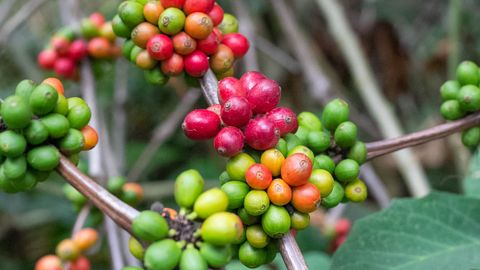
Coffee is both a commodity traded on futures markets and a specialty product sold on quality. The two systems set prices very differently, and most coffee is sold in the first.
The C price
Arabica coffee futures trade on the intercontinental exchange, and the resulting benchmark — the C price — is quoted in cents per pound.
Most commodity coffee is sold at the C price plus or minus a differential reflecting origin, grade and quality.
The C price is set by global supply and demand expectations, weather in Brazil, currency movements and speculative activity. It has very little to do with the cost of producing coffee on any particular farm.
It is also extremely volatile. It has swung by large multiples within a few years, repeatedly.
The production cost problem
The core structural issue.
Studies of production costs across origins have repeatedly found that the C price falls below the cost of production for large numbers of farmers during downturns.
Which means farmers sell at a loss, deplete savings, cut inputs and maintenance, take on debt, or abandon coffee.
Cutting inputs reduces future yields and quality, which deepens the problem in subsequent years.
The 2018 to 2019 period, when the C price fell to levels well below production cost across much of Central America, produced exactly this and contributed to migration from coffee-growing regions.
The specialty premium
Specialty coffee is generally sold at a differential above the C price, or in some cases at a fixed price negotiated independently of it.
Fixed-price contracts decoupled from the commodity market are the more meaningful arrangement, because they protect the producer from volatility rather than simply adding a margin on top of it.
Premiums vary enormously — from a modest differential for ordinary specialty to many multiples of the C price for competition lots and exceptional microlots.
Where the money goes
Take a bag of specialty coffee sold at retail.
The green coffee cost is typically a modest fraction of the retail price.
The rest covers: export and import costs, shipping and insurance, importer margin, roasting, packaging, the roaster's labour and overheads, marketing, distribution, and retail margin.
None of those are illegitimate. They are real costs incurred by real businesses.
The point is not that intermediaries are extracting unfairly, but that the producer's share of the final price is small, and that raising retail prices does not automatically raise farm gate prices.
Farm gate versus export price
An important distinction frequently blurred.
The price a roaster pays is typically an export price, delivered to a port, which includes the exporter's costs and margin, milling, sorting, transport and documentation.
The farm gate price — what the producer receives — is lower, sometimes considerably.
Where a cooperative or washing station is involved, further deductions occur.
Which means a roaster claiming to have paid a high price has not necessarily transferred that to the farm, unless they specify farm gate.
What transparency looks like
A growing number of roasters publish transparency reports.
The useful ones state, per lot: the producer, the quantity purchased, the price paid, whether that is farm gate or free on board, the C price at the time for comparison, and the importer or exporter involved.
Some publish the full cost breakdown to the retail bag.
This is the strongest signal available, because it is verifiable and specific rather than a logo.
The certifications, briefly
Covered elsewhere on this site, and in summary:
Fair Trade guarantees a minimum price and a premium to certified cooperatives. It provides a floor during price collapses, which is genuinely valuable, and it does not guarantee quality or high prices, and certification has costs.
Organic certifies practice, not price.
Rainforest Alliance covers broader criteria with a weaker price mechanism.
None of them is a substitute for knowing what was actually paid.
Climate
The structural pressure behind everything else.
Arabica requires a fairly narrow temperature range and is sensitive to both heat and irregular rainfall.
Modelling has consistently projected substantial reductions in land suitable for arabica cultivation over coming decades, with growing regions moving upslope where possible and disappearing where not.
Coffee leaf rust outbreaks, driven partly by changing conditions, have devastated harvests in Central America.
The responses being pursued include shade systems, drought-tolerant and disease-resistant varieties, and interest in other species better suited to warmer conditions.
What a drinker can actually do
Buy from roasters who publish prices. This directs money toward supply chains that pay more and makes transparency commercially worthwhile.
Buy from roasters with long-term relationships rather than spot purchases, since continuity is worth more to a producer than a single high price.
Pay more, knowingly. The difference between a cheap bag and a good one is small relative to household spending and meaningful in aggregate at origin.
And be sceptical of claims without numbers. Words like ethical and direct are unregulated. Prices are not.