Beans & Origin
Coffee and climate
The structural pressure on the crop over the coming decades, and what is being done about it.
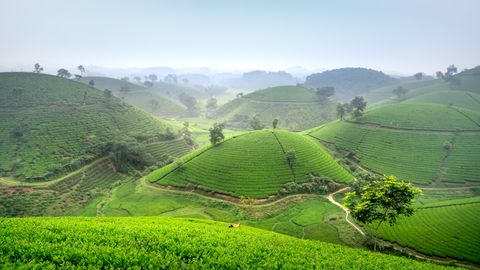
Arabica requires a fairly narrow set of conditions: moderate temperatures, reliable rainfall with a dry period for harvest, and altitude in tropical latitudes.
Those conditions are shifting, and coffee is among the crops most frequently cited as being at risk.
What the modelling projects
Studies have consistently projected substantial reductions in land suitable for arabica cultivation over coming decades, with figures varying by model and scenario but generally indicating losses of a large fraction of currently suitable area.
Suitable zones move upslope, which works where mountains continue upward and does not where they do not.
Robusta is more tolerant of heat and is not immune, and research has indicated its optimal temperature range may be narrower than long assumed.
These are projections rather than certainties, and the direction is consistent across studies.
The mechanisms
Temperature. Higher temperatures accelerate cherry ripening, which reduces the slow development associated with quality.
Extreme heat causes flower abortion and reduces yields.
Rainfall variability. Coffee flowering is triggered by rain after a dry period. Irregular rainfall produces irregular flowering, which means cherries on the same tree ripen at wildly different times, complicating harvest and reducing quality.
Pests and disease. Warmer temperatures extend the range of the coffee berry borer, a beetle that damages cherries directly, upslope into areas previously too cool for it.
Coffee leaf rust, a fungal disease, has caused devastating outbreaks in Central America, with conditions favouring it linked to temperature and humidity changes.
Extreme events. Frost in Brazil, drought, and unseasonal heavy rain during drying all damage crops directly and affect global prices.
The genetic problem
Arabica has unusually low genetic diversity, descending from a small founding population.
Which limits the raw material available for breeding resilience.
Ethiopia's wild populations hold far more diversity and are themselves under pressure from land use change and climate.
Conserving that diversity is a genuine priority, and germplasm collections in several countries hold material that may be needed.
What is being done
Breeding. Programmes developing varieties with heat tolerance, drought tolerance and disease resistance.
Hybrids incorporating robusta genetics — the Catimor and Sarchimor groups, and newer F1 hybrids — offer resistance with cup quality that has improved substantially from early releases.
F1 hybrids in particular, produced by crossing genetically distinct parents, have shown both vigour and quality.
Agroforestry and shade. Growing coffee under a canopy moderates temperature, reduces water stress, supports biodiversity and improves soil.
Shade-grown systems are more resilient and generally lower yielding, which is an economic trade-off for the producer.
Soil management. Organic matter, mulching and cover crops improve water retention and resilience.
Altitude migration, where topography permits — which frequently means clearing forest, with its own consequences.
Alternative species. Renewed interest in liberica, excelsa, and particularly stenophylla, a West African species rediscovered after being considered lost, which reportedly tolerates substantially higher temperatures while cupping comparably to arabica.
Eugenioides, one of arabica's parent species, is being explored for its distinctive low-caffeine sweetness.
These are early and represent genuine options.
The economic dimension
Climate adaptation costs money, and the people who need to invest are the ones with the least.
Replanting with resistant varieties means several years before the new trees produce, during which income falls.
Shade systems reduce yields. Soil improvement takes time.
Smallholders operating at or below the cost of production during price downturns cannot fund any of it.
Which means adaptation depends substantially on price stability and on investment from further up the chain.
This connects the climate question directly to the price transparency question — farms that cannot cover costs cannot adapt.
What it means for drinkers
Prices will rise, and volatility will increase. This is already visible.
Origins will shift. Some current growing regions will decline; others, currently marginal, will become viable.
Varieties will change. More hybrids, more disease-resistant selections, and probably more robusta and other species.
Quality patterns will change, though not necessarily downward. Newer varieties and new growing regions may produce excellent coffee that simply tastes different from what we are used to.
The useful response
Buy from roasters who publish prices and maintain long-term producer relationships, since that is the mechanism by which money reaches farms that need to invest.
Be open to new varieties and origins rather than insisting on the profiles of the past decade.
Try well-made robusta and other species without prejudice.
And accept that good coffee will cost more, because the conditions that made it cheap are ending.
None of that solves the problem. It does put money where it is needed, which is more than most consumer choices manage.