Roasting
Roast profiles and what a curve means
Roasters talk about profiles and rate of rise, which sounds technical and describes something fairly intuitive.
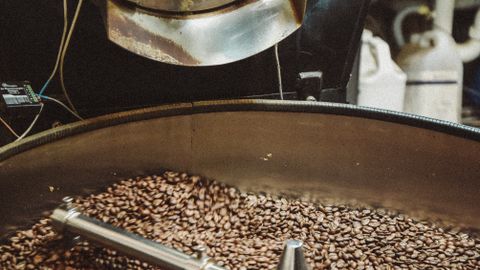
A roast profile is the record of bean temperature against time through a roast, and the decisions made along the way.
Two roasts ending at the same colour can have entirely different profiles and taste nothing alike.
What the curve shows
Plot bean temperature on one axis and time on the other, and you get a curve that rises steeply at first and flattens as the roast progresses.
The interesting information is not the temperature itself but the rate of change.
Rate of rise is how fast bean temperature is increasing, typically expressed in degrees per minute.
It starts high after the charge, drops as the beans absorb energy, and generally declines through the roast.
The phases and their proportions
Roasters divide the roast into three phases and discuss their relative lengths.
Drying phase, from charge to the point where the beans turn yellow. Typically around forty to fifty percent of total time.
Maillard phase, from yellowing to first crack. Typically around thirty to forty percent.
Development phase, from first crack to drop. Typically around fifteen to twenty-five percent.
These proportions are conventions rather than rules, and they vary with the coffee, the machine and the intended profile.
Why declining rate of rise matters
The most widely accepted principle in roasting practice: rate of rise should decline steadily and should not increase or stall.
A stall — rate of rise reaching zero or going negative — is associated with a baked flavour: flat, papery, lacking sweetness and definition.
A spike — rate of rise increasing — is associated with harshness and can cause scorching.
A smooth declining curve is the target, and much of roasting practice is about managing heat application to achieve it.
The evidence base for these principles is largely practical rather than experimental, which is worth acknowledging. They are widely held among roasters and are not laws of physics.
The controls
On a drum roaster, three main variables.
Heat application, the burner or element setting.
Airflow, which affects convective heat transfer and removes chaff and smoke.
More airflow means more convective heat and less conductive; it also removes smoke, which affects flavour.
Drum speed, which affects how much time each bean spends in contact with the hot drum surface.
Plus the charge temperature — how hot the drum is when the beans go in — and the batch size, which determines the thermal load.
Fast versus slow roasts
A genuine stylistic divide.
Faster roasts, perhaps eight to eleven minutes, tend to preserve acidity and aromatic intensity, with less body development.
Associated with the Nordic light roast approach.
Slower roasts, fourteen minutes or more, tend to develop more body and sweetness with less acidity.
Beyond a point, slow roasting produces the baked character, and where that point sits is a matter of judgement.
Charge temperature and batch size
Two decisions made before the roast begins that constrain everything after.
A high charge temperature delivers a lot of energy early, which drives the drying phase quickly and can scorch the surface.
A low charge temperature is gentler and risks a sluggish start with too little momentum.
Batch size relative to the machine's capacity matters enormously. Small batches in a large drum lose heat rapidly to the environment and behave unpredictably; overloaded drums cannot deliver enough energy.
Most machines have a comfortable range, typically somewhere between half and full capacity.
Adjusting for the coffee
Green coffee is not uniform.
Dense, high-grown beans require more energy to roast through and can be roasted harder without scorching.
Softer, lower-grown beans scorch more easily and need gentler heat.
Higher moisture content requires more energy in the drying phase.
Natural processed coffees frequently roast differently from washed, sometimes with more chaff and a tendency to develop faster.
Decaf roasts faster, darkens earlier, and cannot be judged by colour in the usual way.
Which is why a profile developed for one coffee is a starting point rather than a recipe for the next.
What this means for a drinker
You cannot see the profile from the bag. What you can do is taste for its consequences.
Baked coffee tastes flat, papery, low in sweetness, with a dull finish. The roast stalled.
Underdeveloped coffee tastes sour, grassy and sharp, with a hollow finish. Not enough development after first crack.
Scorched or tipped beans show dark marks at the ends or flat faces, and taste burnt. Too much heat too early.
Uneven roasting shows as noticeably different bean colours in one bag.
A roaster whose coffee consistently avoids all of these is doing the job well, whatever their stated philosophy.
Also by Diego Ferrant
- Buying a grinder at every budgetEquipment
- Common myths, correctedWater & Grind
- Coffee in cookingBeans & Origin
- Setting up a small home coffee barEquipment