Water & Grind
Common myths, corrected
A collection of persistent claims about coffee and tea that are wrong, partly wrong, or more complicated than stated.
Coffee and tea attract a remarkable quantity of confidently repeated misinformation.
Dark roast has more caffeine
Wrong, or at best confused.
Caffeine is relatively stable through roasting. Roasting removes mass, so by weight a dark roast has marginally more caffeine per gram; by volume it has less, since the beans are larger and less dense.
The differences are small. Dose and brewing method matter far more.
Espresso has more caffeine than filter coffee
Per millilitre, yes. Per serving, no.
A single espresso typically contains sixty to eighty milligrams. A mug of filter coffee typically contains more, because it is a much larger volume.
Coffee is dehydrating
Overstated.
Caffeine has a mild diuretic effect, and studies of habitual consumers find that coffee at normal intake contributes to daily fluid balance comparably to water.
The same applies to tea.
Coffee stunts your growth
No evidence. The claim appears to have originated from confused associations in older research and has not been supported.
There are reasonable arguments for limiting caffeine in children relating to sleep and anxiety. Height is not one of them.
Storing coffee in the fridge keeps it fresh
Wrong and actively harmful.
The temperature is not low enough to slow degradation meaningfully, humidity is high, and coffee absorbs odours.
Repeated removal and return causes condensation on the beans.
Room temperature in an airtight opaque container, or properly portioned freezing, are the correct options.
Freezing coffee ruins it
Also wrong, which is confusing given the above.
The difference is method. Freezing in small airtight single-use portions, opened only once, preserves coffee well.
Repeatedly freezing and thawing the same bag causes condensation and damage, which is where the reputation came from.
Boiling water burns coffee
Overstated.
Boiling water extracts faster, which can produce over-extraction and bitterness if other variables are unchanged.
It does not scorch or burn the coffee in any meaningful sense, and for light roasts boiling water is frequently appropriate.
Oily beans mean fresh coffee
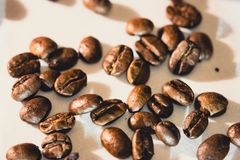
Wrong. Surface oil indicates a dark roast, where the cell structure has broken down enough to push oils out.
Surface oils actually oxidise faster than oils inside the bean, so oily beans stale more quickly.
Blade grinders are fine if you are careful
No. A blade grinder cannot produce a uniform particle size regardless of technique, because it chops rather than sizing.
The resulting mixture of dust and boulders extracts unevenly by design.
Espresso must have thick crema to be good
Not reliably.
Crema is largely carbon dioxide emulsified with oils, so very fresh coffee produces abundant crema regardless of shot quality.
Robusta produces more crema than arabica. Pressurised baskets produce artificial crema from any coffee.
Crema is one indicator among several and is not a quality measure on its own.
Green tea has no caffeine
Wrong. Green tea contains meaningful caffeine, typically twenty to forty-five milligrams per cup.
Matcha, where the whole leaf is consumed, contains substantially more.
You can decaffeinate tea by discarding the first steep
Wrong, and widely repeated.
Studies have found that a short first infusion removes only a modest fraction of the caffeine, far less than the claimed near-total removal.
It also discards a great deal of flavour. If you want low caffeine, choose a low-caffeine tea or a herbal infusion.
Adding milk to tea ruins the antioxidants
Contested and probably overstated.
Some studies have found milk proteins bind polyphenols; others have found no meaningful effect on absorption.
The evidence does not support a confident claim either way, and it is not a reason to change how you drink tea.
Coffee causes dehydration, insomnia and heart problems in everyone
Individual variation is enormous.
Caffeine metabolism varies substantially by genetics, and people differ considerably in sensitivity.
Population guidance suggesting up to around four hundred milligrams daily for healthy adults is a general figure, not a personal prescription.
Anyone with a cardiac condition, anxiety disorder or who is pregnant should take individual medical advice.
Cold brew is much lower in acid
Partly true.
Measured pH differences between cold and hot brew are real and modest. Perceived acidity differs much more, because the compounds that taste bright extract poorly cold.
Whether this helps digestive discomfort varies by individual and is not well established.
Expensive equipment makes better coffee than technique
Backwards.
Fresh coffee, a decent grinder, appropriate water and consistent technique produce excellent coffee on inexpensive brewers.
Expensive brewers with stale pre-ground coffee produce disappointing results reliably.
The general lesson
Most of these persist because they are repeated confidently and because coffee culture rewards certainty.
The useful habit is to ask what the mechanism would be, and whether anyone has actually measured it.
Also by Diego Ferrant
- Buying a grinder at every budgetEquipment
- Coffee in cookingBeans & Origin
- Setting up a small home coffee barEquipment
- Sensory training: learning to tasteWater & Grind