Roasting
What roasting actually does
Ten to fifteen minutes of controlled heat that turns a hard green seed into something worth drinking.
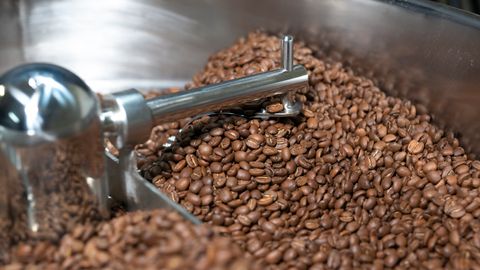
Green coffee smells like hay and tastes of almost nothing. Everything we recognise as coffee flavour is created during roasting.
The process takes somewhere between eight and eighteen minutes in most drum roasting, and a great deal happens in that time.
The stages
Drying. The bean starts at around ten to twelve percent moisture. Heat drives that off. The bean turns from green to yellow, and smells grassy, then like toast or popcorn.
This phase typically takes about half the total roast.
Maillard reactions. As moisture drops and temperature rises, amino acids and reducing sugars react to produce hundreds of new aromatic compounds.
This is the same family of reactions that browns bread crust and seared meat, and it produces most of coffee's complexity — nutty, bready, malty, savoury character.
The bean turns light brown and the smell shifts toward baking.
Caramelisation. Sugars break down under heat, producing sweetness, caramel and toffee character alongside some bitterness.
This overlaps with Maillard rather than following it cleanly.
First crack. An audible cracking, like distant popcorn, as steam pressure ruptures the bean's cell structure.
The bean expands substantially, loses more mass, and becomes brittle.
Coffee is drinkable from around this point. Very light roasts are dropped shortly after.
Development. The period between first crack and the end of the roast, where the flavours created earlier are integrated and acidity is moderated.
Too little and the coffee tastes sour, grassy and underdeveloped — sometimes described as baked or vegetal.
Second crack. A sharper, quieter crackling as the cell structure breaks down further and oils migrate to the surface.
Roasts taken to or past second crack are dark roasts. Origin character is largely gone by this point and the flavour is dominated by the roast itself.
What changes physically
The bean loses roughly fourteen to twenty percent of its weight, mostly water and carbon dioxide.
It expands in volume, sometimes doubling.
It becomes brittle and porous, which is what allows it to be ground and extracted.
It develops a large quantity of carbon dioxide inside its cell structure, which is released over the following days and weeks. This is why fresh coffee blooms and why one-way valves exist on coffee bags.
Acidity, sweetness and bitterness through the roast
The three move in different directions, which is the whole art.
Acidity is highest in light roasts and declines steadily as the roast progresses. Chlorogenic acids break down with heat.
Sweetness rises through the Maillard and caramelisation phases and then falls as sugars are consumed.
Bitterness is low early and rises steadily, becoming dominant in dark roasts.
Which means there is a window where sweetness has developed but acidity has not been destroyed and bitterness has not taken over. Finding it for a particular coffee is what a roaster does.
Why roast levels are not a simple scale
Light, medium and dark are not standardised terms and different roasters use them differently.
More importantly, colour alone does not tell you the roast. Two coffees can reach the same colour by different paths — one roasted fast and one slow — and taste entirely different.
A fast roast can reach a medium colour with the inside underdeveloped, producing a coffee that looks right and tastes sour and thin.
A slow roast can reach the same colour with the flavours stalled, producing something flat and papery, which roasters call baked.
Which is why roast time and the shape of the temperature curve matter, not only the endpoint.
Development time ratio
A figure roasters discuss: the proportion of total roast time occurring after first crack.
Commonly cited targets sit somewhere around fifteen to twenty-five percent, and there is no universal correct figure — it varies with the coffee, the machine and the intended use.
It is a useful shorthand rather than a rule, and roasters who chase the number rather than the taste generally produce worse coffee.
Why origin character survives or does not
Light roasts preserve the compounds that distinguish an Ethiopian from a Colombian. Dark roasts destroy them and replace them with roast character.
Neither is wrong. A dark roast is a legitimate flavour tradition, and it is why traditional Italian espresso tastes the same regardless of what went into it — that consistency is the point.
But if you paid a premium for a distinctive single origin and it was roasted dark, you paid for something you cannot taste.
Also by Diego Ferrant
- Buying a grinder at every budgetEquipment
- Common myths, correctedWater & Grind
- Coffee in cookingBeans & Origin
- Setting up a small home coffee barEquipment