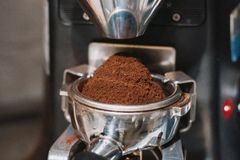
Equipment
Buying a grinder at every budget
What you actually get as you spend more, where the meaningful steps are, and where the price curve stops buying anything you can taste.
Grinder improvement is not linear with price. There are a few large steps and a lot of small ones.
The first step: any burr grinder
The largest single improvement available in coffee.
Moving from a blade grinder or pre-ground coffee to any competent burr grinder produces an obvious, immediate change in the cup.
Grind uniformity improves dramatically, which means extraction becomes even, which removes the simultaneous sourness and bitterness that plagues badly ground coffee.
Nothing else you can buy delivers as much per unit spent.
The hand grinder value proposition
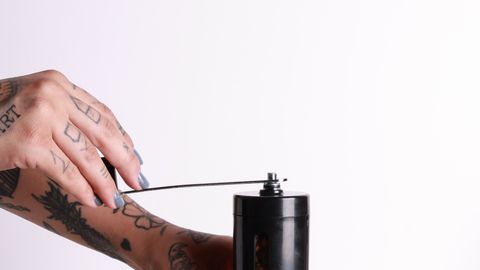
At the lower and middle price ranges, hand grinders substantially outperform electric grinders of equivalent cost.
The reason is straightforward: no motor, no housing, no electronics. The entire budget goes into burrs, bearings and the adjustment mechanism.
A well-regarded hand grinder produces grind quality comparable to electric grinders costing several times more.
The cost is effort. Thirty to sixty seconds of grinding per cup for filter, longer and considerably harder for espresso.
For one or two cups a day, this is manageable. For a household of four, it is not.
What to look for. Stainless steel burrs, a rigid axle with bearings above and below the burrs, and a positive adjustment mechanism.
Axle wobble is the main quality differentiator — a burr that moves during grinding cannot produce consistent particles.
Entry-level electric
Where value is weakest.
Inexpensive electric burr grinders exist and generally have small burrs, poor alignment, plastic construction and coarse adjustment steps.
They are better than blade grinders and worse than hand grinders at comparable prices.
The exception is if you need volume or cannot grind by hand, in which case they serve a real purpose.
Be sceptical of claims that these are espresso capable. Most cannot grind fine enough with sufficient adjustment precision.
The mid-range step
The second meaningful jump.
Grinders in the middle of the market offer: larger burrs, better alignment, more rigid construction, finer adjustment, and lower retention.
The practical result is that they hold their setting reliably, produce a narrower particle distribution, and are genuinely capable of espresso.
This is where most enthusiasts settle and where the price-to-performance curve is most favourable for people making espresso.
The high end
Diminishing returns, and the returns are real.
Large burrs of specialised geometry. Precise alignment from the factory. Very low retention. Stepless adjustment. Substantial build.
The differences in the cup are real and considerably smaller than the price differences.
They matter most for espresso, where small grind changes have large effects, and for people who want to distinguish subtle differences between coffees.
For filter brewing, the gap between a good mid-range grinder and a very expensive one is modest.
Filter versus espresso, again
The most important practical point when budgeting.
Espresso demands much more from a grinder: finer grinding, finer adjustment, and greater consistency because the extraction is so short and so sensitive.
A grinder that produces excellent filter coffee may be unusable for espresso.
If you make only filter, you can spend considerably less and be entirely satisfied.
If you make espresso, the grinder is where the money has to go, and the machine can be modest.
What to check before buying
Burr type and size. Larger generally means faster and cooler grinding.
Adjustment. Stepped or stepless. For espresso, fine steps or stepless. Count how many settings exist in the espresso range specifically.
Retention. How much coffee remains inside between uses. Matters if you switch coffees.
Alignment. Rarely specified and frequently discussed in enthusiast communities. Poor alignment is the most common defect in otherwise good grinders.
Serviceability. Are replacement burrs available? Can it be disassembled for cleaning?
Noise, if you grind early.
Static handling, which varies and which affects mess considerably.
Buying used
Grinders are mechanically simple and hold up well.
Check burr condition — worn burrs produce more fines and lose their sharp edges visibly.
Check that replacement burrs are available for the model.
Commercial grinders appear on the used market and are frequently excellent value, at the cost of size, noise and high retention.
The honest recommendation
If you make filter coffee for one or two people, buy a good hand grinder. You will get quality equivalent to an electric grinder costing several times as much, and the effort is genuinely modest.
If you make filter coffee for a household, buy a decent mid-range electric.
If you make espresso, buy the best grinder you can and economise on the machine.
And in every case, buy the grinder before you buy anything else.
Also by Diego Ferrant
- Common myths, correctedWater & Grind
- Coffee in cookingBeans & Origin
- Setting up a small home coffee barEquipment
- Sensory training: learning to tasteWater & Grind