Beans & Origin
Processing: washed, natural, honey and the rest
What happens to the fruit after picking changes the cup more than almost anything except the roast.
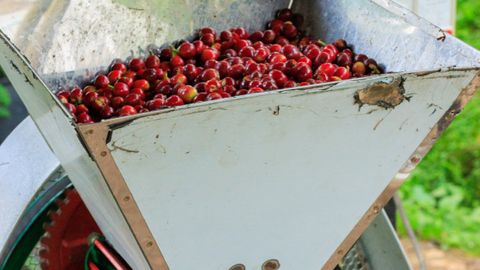
A coffee cherry contains two seeds surrounded by a sticky sugary layer called mucilage, a parchment husk and the fruit skin.
Processing is the business of removing all that and drying the seed. How it is done changes the flavour profoundly.
Washed
Sometimes called wet processed.
The skin and pulp are removed mechanically shortly after picking. The mucilage is then removed, traditionally by fermenting in water tanks for twelve to thirty-six hours and washing, or increasingly by mechanical demucilagers.
The parchment coffee is then dried.
What it tastes like. Clean, bright, articulated. Acidity is more pronounced and more defined. The character of the variety and the terroir comes through clearly because the fruit is not contributing much.
Washed processing is dominant in East Africa, Colombia and much of Central America, and it is generally what people mean when they describe a coffee as clean.
It requires substantial water and infrastructure, which is a real constraint in some growing regions.
Natural
Also called dry processed. The oldest method.
The whole cherry is dried intact, on patios or raised beds, for anywhere from two to five weeks, turned regularly. The dried fruit is then hulled off.
What it tastes like. Fruity, heavy, sweet, sometimes intensely so. Blueberry, strawberry and tropical fruit notes are common in well-executed naturals, particularly from Ethiopia.
Body is heavier and acidity is lower and softer.
Badly executed, naturals taste fermented, boozy, and in the worst cases like something has gone off. The line between spectacular and faulty is narrow, because the fruit is sitting on the seed for weeks and fermentation is happening whether you want it to or not.
Good natural processing requires attentive turning, careful drying and controlled conditions.
Honey and pulped natural
The middle ground.
The skin is removed but some or all of the mucilage is left on during drying.
The names refer to the colour of the drying parchment, which reflects how much mucilage was left and how much light it received.
White and yellow honey leave less mucilage and dry faster in more sun. Closer to washed in character.
Red honey leaves more, dries more slowly.
Black honey leaves all of it and dries slowly in shade, sometimes covered. Closest to natural, with more fruit and body.
Costa Rica popularised the terminology. Brazil's pulped natural is a related approach.
What it tastes like. Sweetness and body of a natural with more clarity, in the better examples.
Anaerobic and experimental processing
The area of most activity in the last decade.
Cherries or depulped coffee are fermented in sealed tanks with limited oxygen, sometimes with controlled temperature, sometimes for extended periods, sometimes with added cultures.
Carbonic maceration, borrowed from winemaking, ferments whole cherries under carbon dioxide.
What it tastes like. Intense, distinctive, sometimes extraordinary and sometimes dominated by the process rather than the coffee.
Notes of cinnamon, tropical fruit, fermented fruit, spirits and unusual florals appear.
Opinions divide sharply. Some drinkers find them thrilling; others find the process character overwhelms origin character to the point where the coffee could be from anywhere.
Both views are reasonable. They are worth trying, and worth recognising that you are tasting a technique as much as a place.
Drying
Underdiscussed and critical.
Coffee must reach a moisture content of roughly ten to twelve percent. Dried too fast and the bean is damaged and unstable. Dried too slowly and mould and off flavours develop.
Raised beds allow airflow underneath and produce more even drying than patios.
Drying is where a great deal of coffee is ruined, and it is also where careful producers make their reputation.
How to use this
The label tells you what to expect.
If you like brightness, clarity and defined acidity, look for washed.
If you like heavy sweetness and fruit, look for natural.
If you want something between, look for honey.
If you want to be surprised, try an anaerobic and accept that you may not like it.
And note that processing interacts with brewing. Naturals tend to suit immersion methods and can be muddy in an over-extracted filter; washed coffees show well in pour over where their clarity is the point.