Beans & Origin
Ethiopia: the origin of the species
Where arabica comes from, where the genetic diversity still lives, and why the coffees taste unlike anywhere else.
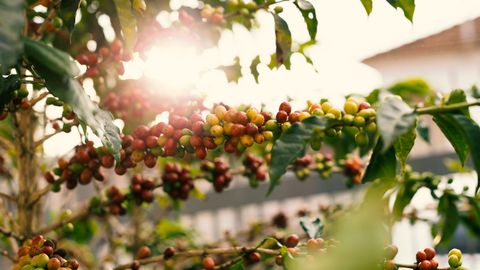
Arabica coffee originated in the forests of southwestern Ethiopia, and wild coffee still grows there.
Which means Ethiopian coffee sits on a genetic base that no other origin has, and it tastes like it.
The heirloom question
Ethiopian coffee is frequently labelled heirloom, which is not a variety name.
It reflects the fact that Ethiopian coffee comprises thousands of local landrace varieties, many uncatalogued, frequently mixed within a single smallholding.
Research institutions have identified and released improved selections, and some lots are now sold with specific variety designations.
For most Ethiopian coffee, heirloom is an honest admission that nobody has catalogued what is growing there — and that diversity is precisely what produces the distinctive complexity.
The regions
Yirgacheffe. The most famous. Within the broader Gedeo zone, at high altitude.
Washed Yirgacheffe is the archetype of floral, tea-like, citric coffee — jasmine, bergamot, lemon, sometimes a distinct black tea quality.
Natural Yirgacheffe is intensely fruity, with blueberry and strawberry notes that seem almost implausible to people encountering them first.
Sidamo. A large region surrounding Yirgacheffe, producing a broad range. Generally bright, citric and floral, with substantial variation between sub-regions.
Guji. Adjacent to Sidamo and increasingly recognised separately. Frequently intense, with stone fruit, tropical and floral character. Naturals from Guji have become highly sought after.
Limu and Djimma, in the west. Generally softer, more balanced, with spice and wine notes.
Harrar, in the east. Traditionally dry processed, producing heavy, wine-like, blueberry-forward coffee with a distinctive rustic character.
Quality has been inconsistent and the style is unmistakable.
How Ethiopian coffee is produced
Overwhelmingly by smallholders, many with well under a hectare, frequently growing coffee alongside food crops in what is effectively a garden system.
Cherries are delivered to washing stations, which process coffee from many farmers.
Which means traceability typically goes to the washing station rather than to an individual farm, and a station lot represents the combined output of hundreds of producers.
Some direct trade relationships now trace to smaller groups and to individual producers, and these are the more expensive lots.
A substantial proportion of Ethiopian coffee is also consumed domestically, which is unusual among producing countries and reflects a genuine coffee culture rather than a purely export commodity.
The trading structure
Ethiopia established a commodity exchange which for a period required most coffee to be sold through it, anonymising lots and breaking traceability.
Reforms have since permitted more direct export and restored traceability for specialty lots, which is why farm-level and station-level information has become more available.
This history explains why older Ethiopian coffee was frequently labelled only by region and grade.
The grading
Ethiopian coffee is graded by defect count, with Grade 1 and Grade 2 representing the highest quality for specialty purposes.
Grade designations appear on bags and are a rough quality indicator rather than a flavour descriptor.
The buna ceremony
Coffee in Ethiopia is prepared in a ceremony that is a genuine social institution rather than a tourist performance.
Green beans are roasted in a pan over coals, ground in a mortar, and brewed in a clay pot called a jebena. It is served in three rounds, each weaker than the last, with incense burning.
The whole process takes an hour or more and is an act of hospitality.
It is worth knowing that the origin of the crop also has the oldest continuous coffee-drinking culture.
How to brew it
Washed Ethiopians reward filter methods that give them clarity — pour over, particularly conical brewers, with a light to medium roast.
Naturals suit both filter and immersion, and can be muddy if over-extracted.
Both are demanding as espresso, and rewarding when dialled in.
Water matters particularly here, since the entire appeal is delicate aromatics that hard water flattens.
Why it costs what it does
Prices for top Ethiopian lots have risen substantially, driven by demand, by climate pressure on growing regions, and by domestic market competition.
Smallholder economics remain difficult, and the gap between what a bag costs in a European café and what reaches a producer remains large.
Roasters publishing farm-gate prices are the ones worth supporting on this point.