Beans & Origin
Colombia, Brazil and the Americas
The largest producing region, spanning everything from commodity volume to some of the most sought-after lots in the world.
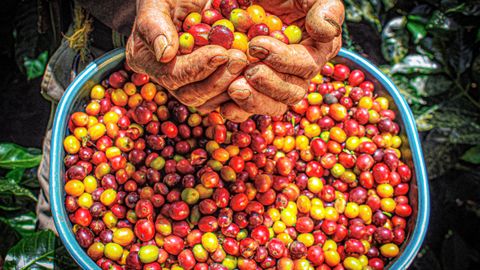
The Americas produce the majority of the world's arabica, across a range of scales and styles that resist generalisation.
Brazil
The largest producer by a wide margin, growing both arabica and robusta.
Much of it is grown at lower altitude than other specialty origins, on relatively flat terrain, which permits mechanical harvesting at a scale impossible elsewhere.
Character. Generally low acidity, heavy body, chocolate, nut and caramel sweetness. Approachable and comforting rather than bright.
This makes Brazilian coffee the backbone of a great many espresso blends, where it provides body and sweetness for more distinctive components to sit on.
Regions. Cerrado Mineiro, Sul de Minas, Mogiana and Bahia among others, each with characteristics.
Processing. Natural and pulped natural dominate, suited to the dry climate at harvest.
Brazil also produces exceptional specialty lots, and the assumption that Brazilian equals commodity is outdated. Competition-winning Brazilian coffees are excellent and increasingly distinctive.
Colombia
Grown across three Andean mountain ranges, which produces enormous variation and, usefully, two harvests per year in some regions.
Character. Balanced, sweet, medium body, caramel and red fruit, moderate to bright acidity depending on region and altitude.
The archetypal well-rounded coffee, which is why Colombian is a default recommendation for people finding their preferences.
Regions. Huila, Nariño, Tolima, Cauca, Antioquia, Santander and others. Nariño and Huila are particularly associated with high-altitude, bright, complex coffees.
Varieties. Caturra, Castillo, Colombia and Typica are widespread. Castillo, a disease-resistant hybrid, was widely planted following leaf rust outbreaks and was initially criticised for cup quality — a criticism that subsequent evidence has substantially softened.
Structure. Overwhelmingly smallholder, with a strong national federation providing extension services, research and a purchase guarantee.
Almost all Colombian coffee is washed, though experimental processing has expanded substantially.
Central America
A collection of small origins with distinct identities.
Guatemala. Volcanic soil, high altitude, mostly washed. Antigua, Huehuetenango and Atitlán are the best-known regions.
Character tends toward chocolate, spice and a firm, structured acidity. Huehuetenango in particular produces bright, complex coffees.
Costa Rica. Known for meticulous production and for pioneering honey processing terminology.
The micro-mill revolution — small producers processing their own coffee rather than delivering to large mills — transformed traceability and quality here.
Character is clean, bright, sweet, frequently with stone fruit and citrus.
Honduras. A large producer that has moved rapidly into specialty. Good value, with regions like Marcala and Santa Bárbara producing excellent coffee.
El Salvador. Small, with a strong Bourbon and Pacamara tradition. Pacamara, a large-bean hybrid, produces distinctive, complex coffee.
Nicaragua and Panama. Panama in particular is known for Geisha, grown in Boquete, which has repeatedly set record auction prices and which produces an intensely floral, tea-like cup unlike anything else.
Mexico. Chiapas, Oaxaca and Veracruz, with a substantial organic sector and generally gentle, chocolate-forward profiles.
Peru and Bolivia
Peru is a large producer with a strong organic and Fair Trade presence, and increasingly recognised specialty lots from regions like Cajamarca and Cusco.
Bolivia produces small quantities of high quality, with a specialty sector that has grown despite difficult logistics.
The common thread
Most coffee in the Americas is washed processed, most is smallholder produced, and most regions are defined by altitude and volcanic soil.
The exceptions — Brazilian naturals, honey processing in Costa Rica, the experimental processing that has spread everywhere — are what makes the region interesting now.
The Americas and processing change
The most notable development across the region in the past decade has been processing experimentation.
Washed processing dominated Central and South America for a century, and honey processing, naturals and anaerobic ferments have spread rapidly — driven partly by competition results and partly by producers seeking differentiation in a crowded market.
Colombia in particular has become a centre of experimental processing, with extended and controlled fermentations producing coffees that taste unlike anything the region produced twenty years ago.
The results divide opinion. Some are extraordinary. Some taste more of the process than of the place, which is a legitimate criticism.
What is not in dispute is that it has given producers a route to higher prices without needing higher altitude or a rarer variety, which for a smallholder is a genuinely useful option.
Choosing among them
If you want balance and approachability, Colombian.
If you want body, sweetness and low acidity, Brazilian.
If you want structure and spice, Guatemalan.
If you want clean brightness, Costa Rican.
If you want to spend a great deal of money on something genuinely remarkable, Panamanian Geisha.
And if you want value, Honduran and Peruvian lots frequently punch well above their price.