Tea
Chinese tea regions and what grows there
The origin of tea and still the most varied producer, across regions with sharply distinct traditions.
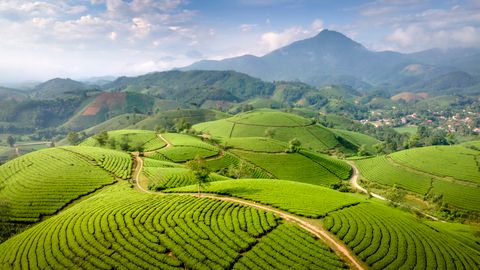
Tea originated in China and every category of tea is still produced there, frequently in the region where it was invented.
Zhejiang
Home to Longjing, or Dragon Well, the most famous Chinese green tea.
Pan-fired by hand into flat, sword-shaped leaves, producing a nutty, chestnut, subtly sweet cup with a distinctive smooth texture.
Genuine West Lake Longjing from the protected area around Hangzhou commands very high prices, and a great deal of tea sold as Longjing is not from there.
Pre-Qingming harvest, picked before early April, is the most prized.
Fujian
Perhaps the most productive tea province, producing several categories.
White tea from Fuding and Zhenghe — Silver Needle, Bai Mu Dan, Shou Mei.
Oolong from two distinct areas.
Anxi, in the south, produces Tieguanyin, historically roasted and now frequently green and floral.
The Wuyi mountains, in the north, produce yancha or rock teas — heavily oxidised, charcoal roasted, mineral and deep.
Black tea, including Lapsang Souchong from the Wuyi area, which is smoked over pine.
The unsmoked original, sometimes called Zheng Shan Xiao Zhong, is a different and considerably more delicate tea than the heavily smoked export version.
Jasmine tea, scented by layering fresh jasmine blossoms with tea over several nights, repeatedly. The best examples use many rounds of fresh flowers and no added oils.
Yunnan
The likely birthplace of the tea plant, with ancient tea trees still growing wild.
Pu-erh, both sheng and shou, is the signature.
Sheng, or raw, is processed like green tea and aged over years or decades, transforming slowly from bright and astringent to deep, sweet and complex.
Shou, or ripe, undergoes accelerated wet-pile fermentation, producing earthy, smooth, sweet character in months.
Pu-erh is frequently compressed into cakes, bricks or nests, which was originally for transport and which affects how it ages.
Terminology around mountains, villages and ages is extensive, and the market has genuine problems with misrepresentation. Buy from vendors who explain their sourcing.
Dian Hong, Yunnan black tea, notable for golden buds and a malty, sweet potato character.
Anhui
Keemun, a black tea with a distinctive wine-like, slightly smoky, floral character. A component of many English breakfast blends historically.
Huangshan Maofeng, a delicate green tea from the Yellow Mountains.
Taiping Houkui, a green tea with remarkably large flat leaves, orchid-scented and mild.
Guangdong
Dan Cong oolong from Phoenix Mountain — single-bush teas named for the aromas they mimic.
Honey orchid, almond, ginger flower, magnolia. Intensely aromatic, and among the most distinctive teas anywhere.
Old bush Dan Cong from ancient trees is expensive and remarkable.
Jiangsu
Biluochun, a green tea rolled into tight spirals, grown interplanted with fruit trees, producing a fruity, floral, delicate cup.
Hunan and Hubei
Producing dark teas including Anhua Hei Cha, compressed and fermented, historically pressed into bricks for trade along the routes into Central Asia.
The naming conventions
Chinese teas are typically named by a combination of place, appearance and legend.
Longjing means Dragon Well, the name of a spring. Biluochun means Green Snail Spring, describing the leaf shape and harvest season. Tieguanyin means Iron Goddess of Mercy.
These names are frequently used generically, so the same name appears on teas from many places and of widely varying quality.
Which means the specific origin, harvest date and vendor matter considerably more than the name on the package.
Buying Chinese tea
Look for harvest year and season, particularly for green teas where spring harvest matters enormously.
Look for specific origin rather than a generic name.
Buy small quantities and taste before committing.
Find a vendor who explains their sourcing and answers questions. The market has a great deal of misrepresentation, and a trustworthy vendor is the practical solution.
Brewing them
Chinese green teas generally take slightly hotter water than Japanese ones — seventy-five to eighty-five degrees — since pan-firing produces a less delicate leaf.
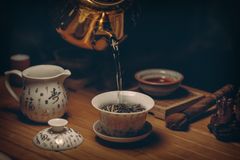
Oolongs, blacks and pu-erh reward gongfu brewing with high leaf quantity and short repeated infusions.
Almost all Chinese tea is designed to be resteeped several times, and a single long steep wastes most of what a good leaf offers.