Beans & Origin
Kenya, Rwanda and East Africa
Some of the most distinctive coffee in the world, produced under structures that differ considerably from origin to origin.
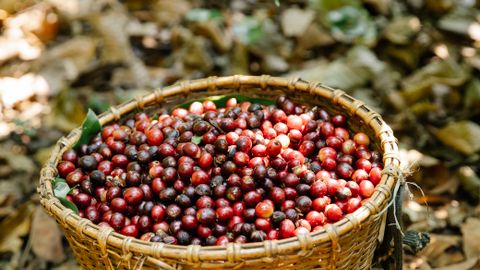
East Africa outside Ethiopia produces coffee with a reputation for intensity and structure that few other regions match.
Kenya
Kenyan coffee is among the most recognisable in the world.
Character. Intense, structured acidity, frequently described as blackcurrant, tomato, or a savoury-sweet quality with a distinctive winey depth.
Full bodied, with a long finish and a juiciness that is unlike anywhere else.
Varieties. SL28 and SL34, selections made at the Scott Laboratories in the 1930s, are largely responsible for the profile. Ruiru 11 and Batian are more recent disease-resistant releases.
Processing. Almost entirely washed, using a distinctive double fermentation and extended soaking process at central factories.
Cherries are pulped, fermented, washed, then soaked in clean water for a further period. This extended process is credited with contributing to the clean intensity.
Grading. Kenyan coffee is graded by screen size, with AA the largest, then AB, then smaller grades including PB for peaberry.
Grade indicates bean size rather than cup quality directly, though larger beans frequently correlate with quality. AB lots are sometimes better value than AA at similar quality.
Structure. Smallholders deliver cherry to cooperative factories. Coffee is sold at a weekly auction in Nairobi, though direct sales have expanded.
The auction system creates transparency about price and complicates traceability, which is why Kenyan coffee is typically identified by factory rather than by farm.
Rwanda
A relatively young specialty origin that has developed rapidly.
Character. Clean, sweet, floral and citric, frequently with a distinctive orange blossom and stone fruit quality. Lighter bodied than Kenyan.
Varieties. Predominantly Bourbon, particularly Red Bourbon, which contributes to the sweetness.
Processing. Mostly washed at central washing stations, with naturals and honeys increasing.
The potato defect. Worth knowing about. A minority of Rwandan and Burundian coffees exhibit a distinctive raw potato aroma in individual beans, caused by bacterial contamination associated with the antestia bug.
It affects individual beans rather than whole lots, is not detectable before brewing, and has been a persistent problem for the region.
Significant work on pest management and sorting has reduced its incidence substantially.
Burundi
Similar in character and structure to Rwanda — washing station based, Bourbon dominant, clean and sweet with floral character.
Frequently excellent value, since it is less well known.
Faces the same potato defect issue and the same logistical challenges of a landlocked country with limited infrastructure.
Tanzania
Produces both arabica and robusta.
Arabica from the slopes of Kilimanjaro and from the southern highlands around Mbeya produces bright, medium-bodied coffee with citric acidity — often compared to Kenyan but gentler.
Peaberry lots are heavily marketed from Tanzania. Peaberry occurs when a cherry develops a single round seed rather than two flat ones, and it is sorted separately.
Whether peaberry tastes better is contested. It roasts somewhat differently due to its shape, and claims of inherent superiority are marketing rather than established.
Uganda
A large producer, historically dominated by robusta, with a growing arabica sector particularly from the Mount Elgon region.
Ugandan robusta is notable as one of the few places where robusta grows wild, and fine robusta from Uganda has attracted specialty attention.
The washing station model
Worth understanding, since it defines the region.
Smallholders with a few hundred trees deliver cherry to a central station, which processes coffee from hundreds of producers.
The station controls processing quality, which means a good station can produce excellent coffee from ordinary farms, and a poor one can ruin good cherry.
Traceability generally goes to the station, and lots are frequently named after it.
Payment to farmers is typically per kilogram of cherry, sometimes with a second payment after sale, which means the relationship between cup quality and farmer income is indirect.
Brewing East African coffee
Filter methods that preserve clarity suit these coffees best, at light to medium roast.
Kenyan in particular has enough structure to stand up to almost any method and is spectacular as pour over.
Water matters here as much as anywhere — the acidity that defines these coffees is exactly what hard water flattens.
As espresso, Kenyan can be intense to the point of aggression and is rewarding when dialled correctly.