Roasting
Cupping: how professionals taste coffee
A standardised method for comparing coffees, which you can do at home with a spoon and some bowls.
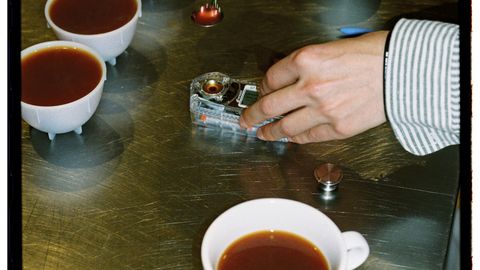
Cupping is a protocol for evaluating coffee, designed to remove brewing variables so that differences between coffees become obvious.
It is how roasters buy, how producers assess their lots, and how competitions are judged.
Why standardise
If you brew two coffees by pour over, differences in grind, pour and technique confound the comparison.
Cupping eliminates that. Everything is identical except the coffee: same dose, same water, same grind, same time, no filter, no technique.
Whatever difference remains is the coffee.
The protocol
Grind coarse-medium, the same for every sample. Grind each sample immediately before, purging the grinder between coffees.
Dose around eight and a quarter grams per one hundred fifty millilitres, or approximately 1:18. Weigh each.
Smell the dry grounds. This is the dry fragrance, and it is part of the evaluation.
Pour water at around ninety-three degrees, to the rim, over all grounds. Do not stir.
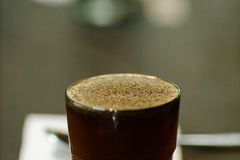
A crust forms.
Wait four minutes.
Break the crust. Push through it three times with the back of a spoon while putting your nose over the cup.
This is the wet aroma and it is the most intense aromatic moment of the process.
Skim the foam and floating grounds from the surface with two spoons.
Wait until it cools to around seventy degrees before tasting. Very hot coffee anaesthetises the palate.
Slurp from a spoon, loudly, aspirating the coffee across the palate.
The slurp is not affectation. It aerates the liquid and drives volatiles into the nasal cavity, where most of what we call taste actually happens.
Taste repeatedly as it cools. Coffee changes substantially between hot and room temperature, and some characteristics only appear cool.
What is assessed
Formal protocols score several attributes. The useful ones for a home taster:
Fragrance and aroma. Dry and wet.
Flavour. The overall character.
Aftertaste. What remains, and for how long. Good coffee lingers pleasantly; poor coffee disappears or turns unpleasant.
Acidity. Not sourness — the bright, lively quality that gives coffee structure. Assessed for quality and intensity separately.
Body. Weight and texture in the mouth.
Balance. Whether the elements work together or one dominates.
Sweetness. Present in well-grown, well-processed, well-roasted coffee.
Uniformity and clean cup. Assessed across multiple cups of the same coffee, checking for defects and inconsistency.
The scores
Formal cupping scores coffee on a hundred-point scale, with eighty and above generally designated specialty.
Scores in the mid-eighties are very good. Above ninety is exceptional and rare.
The scale is only meaningful when applied by trained and calibrated tasters, and even then there is variation between panels.
Cupping at home
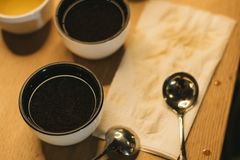
You need: identical bowls or glasses, a scale, a kettle, spoons, and at least two coffees to compare.
Rinse the spoon between samples.
Use several cups per coffee if you can, since it reveals inconsistency.
Taste blind if possible, with someone else pouring, because knowing what you are drinking changes what you taste more than people believe.
Building a vocabulary
The hard part is not tasting differences but naming them.
Start with broad categories: is it fruity, nutty, chocolatey, floral, spicy, earthy?
Then narrow. Fruity — which fruit? Citrus, berry, stone fruit, tropical?
The published flavour wheels are useful for this, working from broad categories to specific descriptors.
Do not worry about matching the roaster's notes. Your associations are yours, and consistency with yourself matters more than agreement with anyone else.
What it will teach you
Within a few sessions you will reliably distinguish washed from natural processing, light from medium roast, and one origin from another.
You will identify which characteristics you actually enjoy, which is frequently different from what you assumed.
And you will start noticing things in your daily cup that you previously drank past — which is the real point.
The defects to learn
Worth recognising because they explain bad coffee.
Ferment, a sharp vinegary or rotten fruit character from processing gone wrong.
Phenolic, a medicinal, chemical character.
Baked, flat and papery from a stalled roast.
Scorched or tipped, burnt notes from excessive heat early in the roast.
Woody, from old crop green coffee.
Rancid, from oxidised oils in stale coffee.
Once you can name these, you can tell whether a disappointing cup is your brewing or the coffee.
Also by Diego Ferrant
- Buying a grinder at every budgetEquipment
- Common myths, correctedWater & Grind
- Coffee in cookingBeans & Origin
- Setting up a small home coffee barEquipment