Roasting
Roasting for espresso versus filter
The same green coffee needs different treatment depending on how it will be brewed, and the reasons are physical.
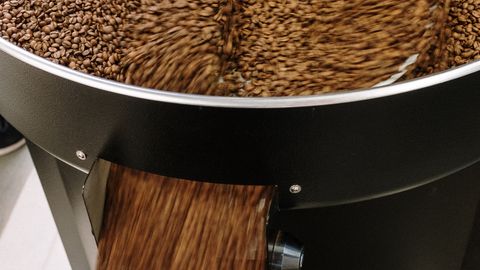
Roasters frequently offer the same origin in two versions. This is not marketing; the requirements genuinely differ.
Why the requirements differ
Contact time. Filter brewing has two to four minutes of contact. Espresso has twenty-five to thirty seconds.
Which means espresso must extract far more in far less time, and that requires the coffee to be more soluble.
Concentration. Espresso is roughly ten times more concentrated than filter coffee.
Concentration amplifies everything, including sourness and bitterness. A pleasant brightness in a filter cup can be aggressive acidity in an espresso.
Grind and pressure. Espresso uses a very fine grind under pressure, which is unforgiving of uneven density.
What roasters do differently
Espresso roasts are generally taken further. More development, sometimes a slightly darker endpoint.
A longer or later development phase increases solubility by breaking down cell structure further, and reduces acidity to a level that survives concentration.
Filter roasts are generally lighter with a shorter development, preserving acidity and aromatic complexity that the longer brew time can extract adequately.
Rate of rise through development is managed differently, with espresso profiles frequently extending the post-crack phase.
The consequences of using the wrong one
A filter roast pulled as espresso tends to be sour, sharp and thin, with an aggressive acidity and difficulty achieving adequate extraction.
It can be made to work with a finer grind, higher temperature, longer ratio and considerable patience — and light-roast espresso is a whole discipline for people who enjoy the challenge.
An espresso roast brewed as filter tends to be heavy, low in acidity, and somewhat flat, with roast character dominating.
Perfectly drinkable, and it wastes the origin character you presumably paid for.
Omni roasts
Coffee roasted to work acceptably in both.
The approach involves a profile in the middle of the range — developed enough for espresso solubility, light enough to retain filter character.
The result is a compromise. Genuinely usable in both, optimal in neither.
Many small roasters offer omni roasts for practical reasons: they cannot carry two versions of every coffee, and most customers brew one way anyway.
This is a reasonable commercial decision rather than a failing.
Milk changes the calculation
An important factor in espresso roasting.
Milk mutes acidity, dulls delicate florals, and adds sweetness and fat.
A coffee that is beautifully balanced as a straight espresso can disappear entirely in a large latte.
Which is why coffees intended for milk drinks are frequently roasted darker still — enough chocolate, caramel and body to be perceptible through the milk.
Roasters who distinguish between espresso for straight shots and espresso for milk are being genuinely helpful.
Resting differs too
Espresso needs more rest after roasting than filter.
Carbon dioxide in freshly roasted coffee disrupts espresso extraction, causing gushing, uneven flow and unstable shots.
Filter is less affected because the brewing is not under pressure.
Typical guidance: filter is good from around three to five days after roast; espresso frequently peaks somewhere between seven and twenty-one days, varying with roast level and packaging.
Which means the same bag can be excellent as filter on day four and difficult as espresso until day ten.
Dialling across the difference
If you brew both from one bag, expect different settings and different results.
For an espresso roast used as filter: brew slightly coarser and cooler than you would a filter roast, and expect body over brightness.
For a filter roast used as espresso: grind finer than usual, use a hotter brew temperature, extend the ratio toward 1:2.5 or 1:3, and expect to need more shots to dial it in.
Both are workable. Neither is optimal.
What to buy
If you brew one way, buy coffee roasted for that.
If you brew both, either buy two bags or accept the compromise of an omni roast.
And if a roaster does not indicate what a coffee is intended for, ask. It is the most useful single question you can put to them.
Also by Diego Ferrant
- Buying a grinder at every budgetEquipment
- Common myths, correctedWater & Grind
- Coffee in cookingBeans & Origin
- Setting up a small home coffee barEquipment