Equipment
Choosing a grinder
The single piece of equipment that changes the cup most, and the one people buy last.
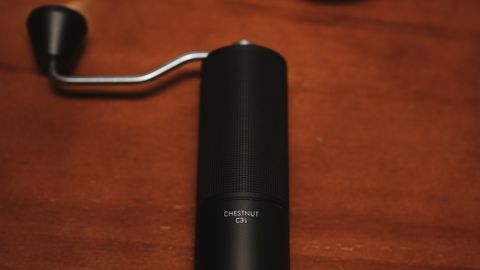
If you are choosing between spending money on a brewer or a grinder, buy the grinder.
Grind consistency determines how evenly the coffee extracts, and uneven extraction is the most common cause of a cup that tastes simultaneously sour and bitter.
Blade versus burr
The first and largest distinction.
Blade grinders chop coffee with a spinning blade. They produce a wide range of particle sizes — boulders and dust in the same batch.
The dust over-extracts and turns bitter; the boulders under-extract and stay sour. Both end up in the same cup.
They also heat the coffee and offer no real control over grind size beyond how long you hold the button.
Burr grinders crush coffee between two abrasive surfaces set a fixed distance apart. Particles cannot pass until they are small enough to fit through the gap, which produces a far more consistent result.
The difference in the cup is immediately obvious. This is the upgrade people notice most.
Conical versus flat burrs
Both are burr grinders and they behave slightly differently.
Conical burrs use a cone inside a ring. Generally cheaper to produce, quieter, retain less coffee, and typically produce a distribution with a small secondary peak of fines.
Frequently described as producing more body and a slightly rounder cup.
Flat burrs use two parallel discs. Generally produce a narrower particle distribution, associated with more clarity and separation of flavours.
Usually more expensive, often noisier, and often retain more coffee in the chamber.
The differences are real and smaller than the difference between a poor burr grinder and a good one. Do not agonise over it.
Hand versus electric
Hand grinders offer remarkable value. A good hand grinder can match or exceed electric grinders costing several times as much in terms of burr quality and consistency.
The trade-off is effort and time — roughly thirty to sixty seconds of grinding per cup, more for finer espresso grinds, which is genuinely hard work.
Excellent for filter coffee, for one or two cups, and for travel.
Electric grinders are faster and easier, essential if you are grinding for several people or making espresso regularly.
The entry point for a genuinely good electric grinder is meaningfully higher than for a hand grinder of equivalent quality.
Filter versus espresso
An important practical point.
Espresso requires a very fine grind with fine adjustment — the difference between a good and a bad shot can be a fraction of a turn on the adjustment.
Many inexpensive grinders that are perfectly good for filter cannot grind fine enough or adjust precisely enough for espresso.
Check specifically whether a grinder is espresso capable before buying, and be sceptical of claims. A grinder that technically reaches espresso fineness but adjusts in large steps is not usable for espresso.
Grinders that do both well exist and cost more.
What to look for
Burr quality and size. Larger burrs grind faster and cooler. Material and geometry matter more than size alone.
Adjustment mechanism. Stepless adjustment offers infinite control; stepped adjustment is easier to return to a known setting. For espresso, fine steps or stepless is important. For filter, stepped is fine.
Alignment. Burrs that are not parallel produce inconsistent grind. Better grinders have tighter tolerances, and alignment can sometimes be improved on cheaper models with shims.
Retention. Coffee left in the grinder between uses goes stale and contaminates the next dose. Low retention matters if you switch coffees frequently.
Build and serviceability. Can burrs be replaced? Are parts available? Burrs do wear out, over years and tens of kilograms.
Grinding fresh
Worth stating because it is the other half of the point.
Ground coffee stales dramatically faster than whole beans — the surface area exposed to oxygen increases enormously.
Aroma compounds begin escaping within minutes. Coffee ground a week ago is a different and worse product than coffee ground now.
Grind immediately before brewing. This is not affectation; the difference is easily detectable.
Maintenance
Coffee oils accumulate on burrs and go rancid, which produces a stale taste that no fresh coffee overcomes.
Brush out the burr chamber regularly. Disassemble and clean properly every few months.
Grinder cleaning tablets exist and work, particularly for grinders that are awkward to disassemble.
Replace burrs when grind quality noticeably degrades and adjustment no longer behaves predictably.
The sensible order of spending
Fresh coffee from a roaster who prints a roast date. Then a burr grinder. Then decent water. Then a scale. Then whatever brewer appeals.
An expensive brewer with pre-ground supermarket coffee will disappoint. A cheap brewer with freshly ground good beans will not.
Also by Diego Ferrant
- Buying a grinder at every budgetEquipment
- Common myths, correctedWater & Grind
- Coffee in cookingBeans & Origin
- Setting up a small home coffee barEquipment