Brewing Methods
Espresso at home: what actually matters
The most demanding brewing method, where small errors are magnified and the grinder matters more than the machine.
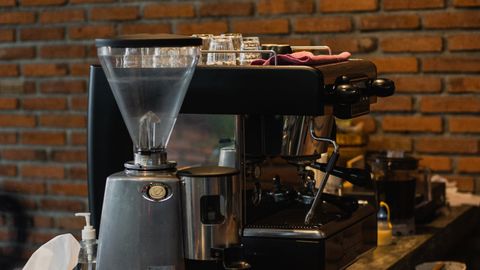
Espresso is coffee brewed by forcing hot water through a compressed bed of finely ground coffee under pressure.
The parameters are tight, the feedback loop is fast, and everything you did wrong shows up in the cup.
The reference points
Traditional espresso parameters, offered as starting points rather than laws.
Dose of eighteen to twenty grams in a standard double basket.
Yield of roughly double the dose — thirty-six to forty grams out — which is the ratio people call 1:2.
Extraction time of twenty-five to thirty-two seconds from the start of the pump.
Water temperature around ninety-three degrees Celsius, higher for lighter roasts and lower for darker.
Pressure around nine bar, which most machines target.
Ratios vary by intent. A ristretto is shorter, around 1:1.5, producing something denser and sweeter. A lungo is longer, around 1:3, producing something lighter and more extracted.
Dialling in
The process of adjusting grind to hit your target yield in your target time.
Fix the dose and the target yield. Change only the grind.
Shot runs too fast, under target time, tastes sour and thin. Grind finer.
Shot runs too slow, over target time, tastes bitter and harsh. Grind coarser.
Adjust in small increments and pull a shot after each change. Expect to waste several doses when opening a new bag — this is normal and every café does it.
Once time and yield are on target, taste. If it is still sour, raise temperature or extend the ratio slightly. If it is bitter, lower temperature or shorten the ratio.
Puck preparation
Where most home espresso problems actually originate.
The enemy is channelling — water finding a low-resistance path through the puck, over-extracting there and under-extracting everywhere else.
A channelled shot tastes both sour and bitter, sprays unevenly, and produces a puck with visible holes.
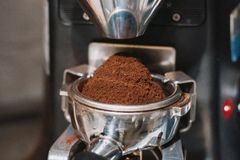
Distribute evenly. Coffee falls from a grinder in a mound. Level it before tamping, using a distribution tool or by tapping and stirring gently with a needle tool.
Needle distribution — stirring the dry grounds with fine needles — breaks up clumps and is genuinely effective.
Tamp level. Pressure matters less than people think; consistency and levelness matter enormously.
Around fifteen to twenty kilograms of force is the traditional figure, and any consistent firm pressure works provided the tamp is flat.
A tilted tamp guarantees channelling.
Do not tap the portafilter after tamping, which can crack the puck and create a channel.
Reading the shot
Watch it.
First drops appearing after five to eight seconds, then a steady stream that darkens gradually. Good.
Dripping for fifteen seconds then suddenly gushing. Channelling.
Spraying, or streams from separate holes at different rates. Uneven puck.
Pale and fast throughout. Too coarse.
Dark and dripping, barely producing anything. Too fine, or dose too high for the basket.
Look at the puck afterward. It should be a firm, even disc. A wet, soupy puck usually means the dose is too low for the basket, leaving headroom.
What the machine needs to do
Only two things well: stable temperature and adequate pressure.
Temperature stability is the main difference between cheap and expensive machines. A machine whose brew temperature swings by several degrees between shots cannot be consistent.
Pressure is straightforward for most pump machines. The pressurised baskets supplied with entry-level machines are a different matter — they create artificial back pressure and produce a foamy crema regardless of grind, which means they mask grind problems rather than solving them.
Replacing a pressurised basket with a standard one is a cheap and dramatic upgrade, provided your grinder can keep up.
The grinder point again
An excellent machine with an inadequate grinder produces bad espresso. A modest machine with an excellent grinder produces good espresso.
Espresso requires very fine grinding with very fine adjustment. Most grinders sold as espresso-capable at low prices are not, in practice, because their adjustment steps are too coarse.
If you are budgeting, weight it toward the grinder.
The other essentials
A scale that measures to a tenth of a gram, for dose and yield. Guessing yield by eye is guessing.
A timer.
Fresh coffee, ideally rested five to fourteen days after roasting. Very fresh coffee is full of carbon dioxide and produces unstable, gassy shots.
A bottomless portafilter, which shows you exactly where channelling occurs and is the best diagnostic tool available.
The realistic expectation
Home espresso has a genuine learning curve, and the first weeks are frustrating.
Every new bag requires re-dialling. Humidity changes behaviour. The same coffee behaves differently at day four and day fourteen after roasting.
People who enjoy that process love espresso. People who want good coffee with minimal fuss are frequently better served by a good filter method and a milk frother.
There is no shame in the second position. A well-made pour over is a better drink than a badly made espresso.
Also by Diego Ferrant
- Buying a grinder at every budgetEquipment
- Common myths, correctedWater & Grind
- Coffee in cookingBeans & Origin
- Setting up a small home coffee barEquipment