Brewing Methods
French press, and why it is better than its reputation
Full immersion, no paper, heavy body — and a technique adjustment that removes almost all the sludge people complain about.
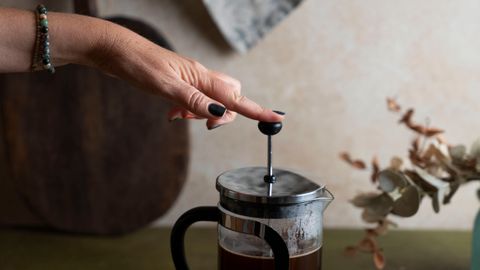
The French press has a poor reputation among people who care about coffee, largely because most people use it badly.
Done properly it produces a rich, heavy, sweet cup with a texture no filter method can match.
Why it tastes different
Two reasons.
No paper filter. Paper traps oils and very fine particles. A metal mesh does not.
Those oils carry aroma and body. Their presence is the whole character of the method.
Full immersion. All the coffee sits in all the water for the whole time, which produces a more even extraction than a percolation method where water passes through progressively.
The consequence is a cup with more texture and less clarity than pour over — heavier, rounder, less articulated.
The standard recipe
Around sixty to seventy grams of coffee per litre. For a typical three-cup press, that is roughly thirty grams of coffee to five hundred of water.
Coarse grind, like coarse sea salt.
Water around ninety-three to ninety-six degrees.
Four minutes.
The technique that changes everything
Most sludge in a French press comes from stirring at the end and from plunging hard.
The method that removes nearly all of it:
Add coffee, add all the water.
Wait four minutes. Do not stir yet.
A crust forms on the surface — grounds held up by carbon dioxide.
Break the crust by stirring gently, two or three times, with a spoon.
Most of the grounds will sink.
Skim the foam and floating grounds off the surface with two spoons, and discard them.
Wait another five to eight minutes. Yes, really. The remaining fines settle to the bottom.
The coffee will still be hot enough, and it will have cooled into the range where you can actually taste it.
Press the plunger just to the surface, not down through the coffee. It is only there to hold the grounds back as you pour.
Pour gently, and stop before the last centimetre.
The result is a clean, heavy, sweet cup with almost no grit.
Why the extended wait works
Extraction slows dramatically as the water cools and as the concentration in the water approaches equilibrium with the grounds.
Which means the extra minutes of settling add far less extraction than people assume. The cup does not become bitter.
Plunging hard, on the other hand, forces water through the bed under pressure and stirs fines back into suspension — which is what produces both the grit and the harshness people associate with the method.
Grind
The most common failure.
Too fine and you get sludge, a stiff plunge and a bitter cup. Blade grinders produce a huge range of particle sizes and are particularly bad here, because the fines pass straight through the mesh.
Coarse and even is what the method wants. This is the brewing method where grinder quality shows up most obviously in the cup.
Cleaning
Oils build up in the mesh and on the glass and go rancid, which produces a stale, fatty taste that no recipe fixes.
Disassemble the plunger — the filter screws apart — and wash all the parts properly, regularly.
People clean the beaker and never the mesh, and then wonder why the coffee has gone off.
Ratio and time, adjusted deliberately
The standard four minutes is a convention rather than a finding, and it is worth moving.
A longer steep at a coarser grind — eight or ten minutes — produces a gentler, sweeter cup with less of the harshness people associate with the method.
The reason it does not become bitter is that extraction slows sharply as the water cools and as the concentration in the liquid approaches equilibrium with the grounds. The last four minutes add far less than the first four.
A shorter steep at a finer grind produces something brighter and more articulated, closer in character to a filter brew.
On ratio, the standard sixty to seventy grams per litre suits most coffees. Pushing toward eighty produces something closer to a concentrate, which is excellent with milk.
Because the method is forgiving, experimenting costs nothing but a cup, and the range of results available from one device is wider than most people realise.
What it suits
Darker and medium roasts, where body and sweetness matter more than delicate acidity.
Chocolate-forward, nutty, heavier coffees.
Mornings when you want to start something and walk away.
Bright, delicate, floral coffees are generally better served by a filter method that gives them clarity, though this is a preference rather than a rule.
The variations
Some people brew for eight or ten minutes at a coarser grind, which produces a gentler, sweeter cup.
Some use a lower temperature to reduce bitterness with darker roasts.
Both are worth trying. The method is forgiving enough that experimenting costs you nothing but a cup.
Also by Marcus Obeng
- What we would tell someone starting outEquipment
- When your coffee suddenly gets worseEquipment
- A morning routine that produces good coffee every dayBrewing Methods
- Coffee grounds and wasteEquipment