Tea
Matcha, and what makes it different
Shade-grown leaf stone-ground into powder and whisked into water, which means you consume the leaf rather than an infusion.
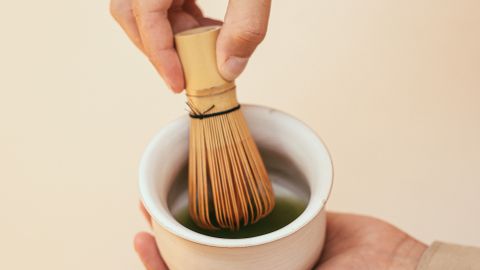
Matcha is powdered green tea, whisked into water rather than steeped and strained.
The whole leaf is consumed, which changes both the flavour and the chemistry.
How it is produced
Shading. The defining step. The plants are covered for roughly three to four weeks before harvest, blocking most sunlight.
This increases chlorophyll, producing the intense green colour, and increases theanine — an amino acid associated with umami and sweetness — while reducing catechins, which produce astringency.
The result is a sweeter, more savoury, less bitter leaf.
Steaming and drying. The leaves are steamed to halt oxidation, then dried.
Deveining and destemming. Stems and veins are removed, leaving only the leaf flesh. This intermediate product is called tencha.
Stone grinding. Tencha is ground on granite mills, slowly, producing a very fine powder.
The slowness matters — grinding generates heat, and heat damages the tea. Traditional mills produce only a modest quantity per hour, which is a substantial part of why good matcha is expensive.
Grades
Terminology is not regulated and is used loosely, and the broad distinction holds.
Ceremonial grade refers to matcha suitable for drinking with water alone. Made from the youngest leaves of the earliest harvest, finely ground, vivid green, sweet and smooth with minimal bitterness.
Culinary or latte grade is made from later harvests and more mature leaves. More astringent and more robust, which is appropriate when it will be mixed with milk and sugar.
Using ceremonial grade in a sweetened latte wastes both the money and the subtlety. Using culinary grade in water produces something harsh.
Between them sits a broad middle used for everyday drinking.
Judging quality
Colour. Vivid, almost fluorescent green. Dull, yellowish or brownish powder indicates older leaf, oxidation or poor storage.
Texture. Extremely fine, like talc. It should feel silky rather than gritty.
Aroma. Sweet, vegetal, marine.
Origin. Uji, Nishio, Yame and Kagoshima are the principal Japanese producing regions, each with characteristics.
Harvest date. Matcha degrades quickly once ground. Look for a date and buy small tins.
Preparation
Two traditional styles.
Usucha, thin tea. Roughly two grams of matcha to sixty or seventy millilitres of water at around seventy to eighty degrees.
Whisked briskly in a W or M motion with a bamboo whisk until a fine foam forms.
Koicha, thick tea. Roughly four grams to thirty millilitres, kneaded rather than whisked into a thick paste.
Used in formal tea ceremony and requires high-grade matcha.
The practical steps that improve results:
Sift the powder before whisking. Matcha clumps, and clumps do not disperse. A small sieve solves it entirely.
Use water below boiling. Around seventy-five degrees. Boiling water makes matcha bitter.
Soak the bamboo whisk briefly in warm water first, which softens the tines and prevents breakage.
Whisk vigorously, from the wrist, not in circles. Circles do not aerate.
A milk frother or a small electric whisk works if you do not have a chasen, though it produces a different foam.
Caffeine and theanine
Because you consume the whole leaf, matcha delivers more caffeine per serving than most steeped teas — comparable to a modest coffee.
It also delivers substantial theanine, which is associated with a calmer subjective quality of alertness. This combination is the basis of matcha's reputation for focused energy.
The research on theanine and attention is developing rather than settled, and the effect is widely reported by drinkers.
Storage
Matcha degrades faster than any other tea. Ground powder has enormous surface area and oxidises quickly.
Airtight, refrigerated once opened, away from light and odours, used within a few weeks.
Bring the tin to room temperature before opening to avoid condensation.
Buy thirty gram tins rather than large quantities, however tempting the price.
Beyond the bowl
Matcha lattes, iced matcha, and matcha in baking are all legitimate and are not what ceremonial grade is for.
For a latte, use a robust culinary or latte grade, sift it, whisk it into a small amount of water first to make a smooth paste, then add milk.
Adding powder directly to milk produces lumps that never disperse.