Tea
Gongfu Brewing And The Case For More Leaf
Using a high ratio of leaf to water with very short steeps sounds wasteful, yet it extracts less per infusion and reveals a sequence a single steep cannot.
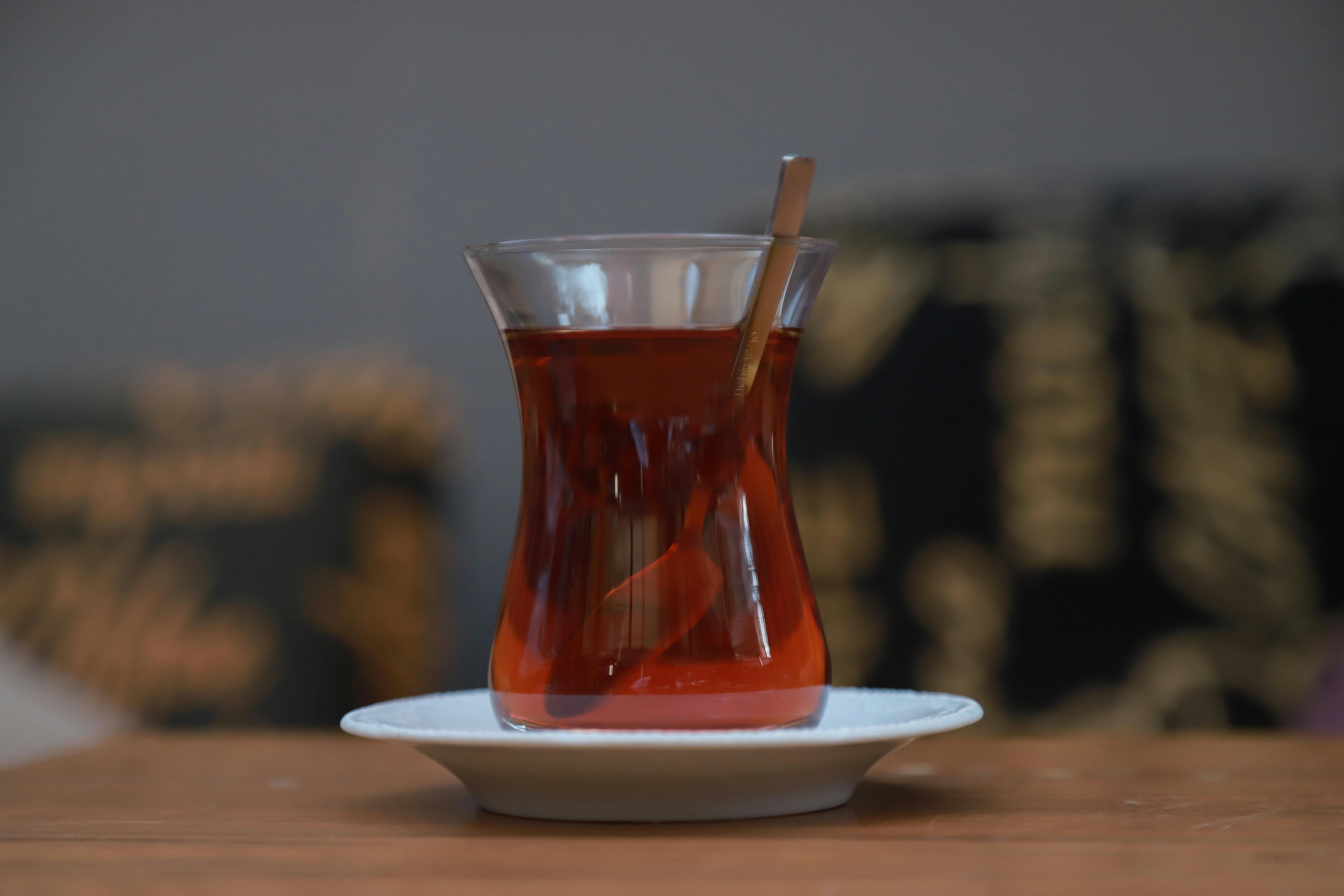
The gongfu approach uses a great deal of leaf in a small vessel and steeps it for seconds at a time. The logic behind that apparent excess is straightforward once the arithmetic is laid out.
High ratio, low extraction per steep
Strength in the cup depends on how much dissolved material is present relative to the water. With a large quantity of leaf, only a small fraction needs to dissolve to reach full strength.
A short steep therefore produces a concentrated cup while leaving most of the leaf's material untouched and available for the next round.
A conventional pot does the opposite: little leaf, long steep, most of the available material taken at once and the leaf discarded.
The bitter fraction is largely avoided
Compounds that read as bitter and harshly astringent tend to come out later in an extraction rather than at the very start.
Keeping each infusion brief means the water is removed before that fraction contributes much, so strength rises without harshness following it.
This is why a gongfu cup can be intensely flavoured yet smooth, a combination that is difficult to achieve with a long single steep.
A session has a shape
Early infusions emphasise aroma and brightness, since the most soluble and volatile material leaves first and the leaf has not yet fully opened.
Middle rounds are typically the thickest and sweetest, with the leaf fully unfurled and a broad range of compounds available at once.
Later rounds thin out towards mineral, woody and quiet character, and following that progression is much of the point of brewing this way.
The equipment follows from the method
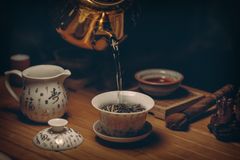
Small vessels are used because a short steep must be poured off completely and quickly, which is impractical with a large pot.
A wide mouth and a fast pour both matter, since seconds of delay in decanting represent a large proportional change to a ten-second infusion.
Nothing about the approach requires any particular material or provenance of teaware, though tradition has attached a great deal of both.
It suits some teas far better than others
Tightly rolled oolongs, compressed dark teas and whole-leaf blacks all open gradually and reward many rounds.
Broken leaf and small particles give everything up at once and produce a fierce first cup followed by nothing, so the method offers them little.
Matching the approach to leaf that can sustain it is the difference between a long, evolving session and a very strong single cup.