Water & Grind
Ratios and why you should weigh things
A scale costs very little and converts brewing from a guess into something you can repeat.
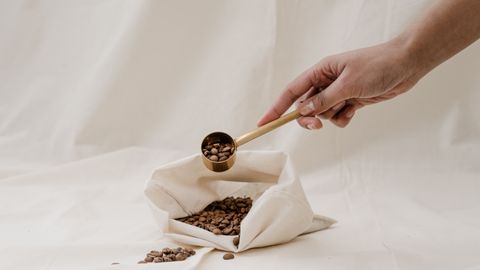
The single most useful piece of equipment after a grinder is a scale, because without one you cannot repeat a result.
Why volume measurement fails
A scoop of coffee varies enormously in weight depending on grind size, roast level and bean density.
A tablespoon of light roast whole beans, a tablespoon of dark roast whole beans, and a tablespoon of ground coffee are three different quantities.
Dark roasts are less dense than light roasts, so the same volume weighs less and produces a weaker brew.
Which means recipes given in scoops are unreliable across coffees, and the same scoop that worked last month produces something different with a new bag.
The ratios
Expressed as coffee to water by weight.
Filter and pour over: around 1:15 to 1:17. Fifteen grams of coffee to two hundred fifty grams of water is roughly 1:16.7.
Some describe this as grams per litre — sixty grams per litre is a common specification and equals about 1:16.7.
French press: around 1:14 to 1:17, frequently on the stronger side.
Aeropress: highly variable by recipe, from around 1:10 for concentrate to 1:16 for filter style.
Moka pot: dictated by the pot's dimensions.
Espresso: around 1:2 for a standard shot, 1:1.5 for ristretto, 1:3 for lungo.
Cold brew: around 1:8 to 1:12 for a concentrate to be diluted, or 1:15 to 1:17 for ready-to-drink.
Water measured by weight
One millilitre of water weighs approximately one gram, so measuring water on a scale is both easier and more accurate than using a jug.
It also lets you pour directly onto the scale and watch the number, which is how pour over is best controlled.
Ratio versus extraction
An important distinction covered elsewhere and worth restating.
Ratio primarily controls strength — how concentrated the finished drink is.
Grind, time and temperature primarily control extraction — how much you pulled out of the grounds.
If a cup tastes weak but pleasant, use a tighter ratio: more coffee, same water.
If it tastes sour or bitter, the problem is extraction and changing the ratio will not fix it.
People frequently respond to a sour cup by adding more coffee, which makes it stronger and still sour.
Choosing a scale
Resolution of 0.1 grams for espresso, where a gram matters. One gram resolution is adequate for filter.
Capacity of at least two kilograms, so a full carafe on the scale does not exceed it.
Response speed. Slow scales are frustrating for pour over, where you are watching the number while pouring.
A built-in timer is convenient and not essential.
Water resistance, since brewing involves spillage.
A flat top large enough for your brewer.
Inexpensive kitchen scales work adequately for filter brewing. Espresso benefits from something faster and more precise.
What to record
A brewing log sounds excessive and is genuinely useful for the first few weeks with new equipment.
Coffee name and roast date. Dose in grams. Grind setting. Water weight. Water temperature. Total brew time. And two or three words about how it tasted.
After a dozen entries you will see patterns that no guide could have told you, because they are specific to your grinder and your water.
Once you have a settled recipe you can stop recording, and start again when something changes.
Adjusting a ratio deliberately
Ratio is a preference rather than a rule.
People who find specialty coffee weak frequently want a tighter ratio — more coffee per unit water — rather than more extraction.
People who find it overwhelming want a wider one.
Experiment by holding grind and time constant and moving the ratio in steps. The effect is immediately obvious and it is a legitimate way to make coffee taste the way you want it to.
Bypass
A technique worth knowing.
Brew at a tighter ratio than your target, then add hot water to the finished cup to reach the strength you want.
This decouples extraction from strength entirely. You extract a smaller volume well, then dilute to taste.
It is how a proper americano is made, and it is useful for anyone who wants a large mug without brewing a large weak batch.
Also by Marcus Obeng
- What we would tell someone starting outEquipment
- When your coffee suddenly gets worseEquipment
- A morning routine that produces good coffee every dayBrewing Methods
- Coffee grounds and wasteEquipment