Water & Grind
Building a water recipe
For anyone who has fixed everything else and still is not getting the cup they want.
Once your coffee is fresh, your grinder is decent and your technique is consistent, water is the remaining variable — and the one you can control most precisely.
This is the enthusiast end of the subject. It is also cheap and genuinely effective.
The principle
Start with water containing essentially nothing, then add exactly the minerals you want.
The base is distilled water, deionised water, or reverse osmosis output.
Distilled is available cheaply in most supermarkets and is completely consistent, which is the point.
The additions
Three compounds cover almost everything.
Magnesium sulfate, sold as Epsom salt. Provides magnesium, associated with brightness and extraction of fruit character.
Calcium chloride or calcium sulfate. Provides calcium, associated with body and a rounder mouthfeel.
Sodium bicarbonate, ordinary baking soda. Provides alkalinity, which buffers acidity and prevents an overly sharp cup.
Use food-grade materials. Epsom salt sold for bathing may contain fragrances and should not be used.
The concentrate method
Weighing tiny quantities into a litre of water is impractical. Instead make concentrates.
Dissolve a measured quantity of each compound into a litre of distilled water separately, producing three stock solutions.
Then add a few millilitres of each to a litre of distilled water to produce brewing water.
Published recipes specify the concentrate strength and the dosing, and several well-documented formulations circulate among enthusiasts.
Alternatively, commercial mineral sachets are sold specifically for this. Each sachet treats a fixed volume, which removes all the arithmetic at higher cost per litre.
Where to aim
Common target ranges, expressed as parts per million:
General hardness, meaning calcium and magnesium combined, somewhere between fifty and one hundred fifty.
Alkalinity around forty.
Total dissolved solids in the region of one hundred fifty.
Within that, the ratio of magnesium to calcium is where the interesting variation sits.
The experiment worth running
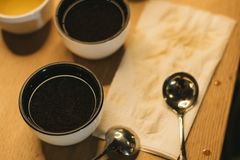
Make three waters and brew the same coffee with each, side by side.
High magnesium, low calcium, low alkalinity. Expect brightness, fruit intensity, sharper acidity, lighter body.
High calcium, low magnesium. Expect a heavier, rounder, softer cup with less defined acidity.
Higher alkalinity. Expect a flatter, gentler cup with acidity suppressed.
The differences are not subtle. This single experiment convinces most sceptics.
Matching water to coffee
Once you can taste the difference, you can adjust deliberately.
A delicate washed Ethiopian benefits from higher magnesium and low alkalinity, which brings out the florals.
A darker roast or a heavy natural benefits from more calcium and slightly more alkalinity, which rounds it off and softens any harshness.
Espresso frequently benefits from somewhat higher total mineral content than filter, and this is contested.
The espresso machine warning
Do not put pure distilled or deionised water through an espresso machine.
Machines with boilers rely on some conductivity for water level probes to function, and very pure water can cause them to misread and overfill.
Very low alkalinity water can also be corrosive to boiler components.
Manufacturers specify acceptable water parameters. Follow them, and accept a compromise that protects the machine.
Recipes exist that are formulated to be machine-safe, with adequate alkalinity to prevent corrosion and low enough hardness to prevent scale.
Measuring
A total dissolved solids meter is cheap and gives a rough indication, and does not distinguish which minerals are present.
Aquarium test kits for general hardness and carbonate hardness are inexpensive and give the two numbers that actually matter.
For built water, measurement is largely a check rather than a necessity — if you added a known quantity to a known base, you know what is in it.
The proportionality reminder
This is a refinement, not a foundation.
Fresh coffee, a good grinder and consistent technique matter more. Filtered tap water or a suitable bottled spring water gets most of the benefit for almost no effort.
Building water is for people who have done everything else and want the last increment — and who enjoy this sort of thing, which is a legitimate reason on its own.
Also by Marcus Obeng
- What we would tell someone starting outEquipment
- When your coffee suddenly gets worseEquipment
- A morning routine that produces good coffee every dayBrewing Methods
- Coffee grounds and wasteEquipment