Water & Grind
Grind size, and how to find yours
The most powerful lever in brewing, described everywhere in analogies that mean nothing until you have something to compare against.
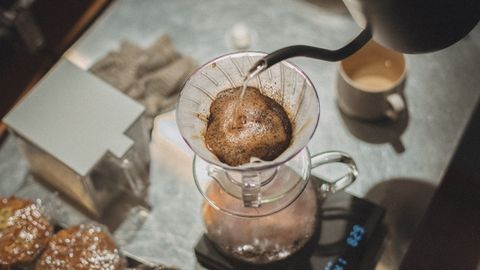
Grind size determines how fast water extracts from coffee, because it determines surface area.
Every brewing method has a range that works, and finding yours is mostly a matter of systematic adjustment rather than of matching a description.
The rough map
Standard comparisons, offered with the caveat that they are approximate and that grinders differ enormously.
Extra fine, like flour or powdered sugar. Turkish coffee.
Fine, like fine sand or table salt slightly crushed. Espresso.
Medium-fine, between sand and coarse salt. Moka pot, some pour over, siphon.
Medium, like coarse sand or table salt. Most pour over, flat bottom brewers, automatic drip.
Medium-coarse, like coarse sea salt. Larger pour over batches, Chemex, some immersion.
Coarse, like coarse sea salt or raw sugar. French press, percolators.
Extra coarse, like peppercorns cracked. Cold brew.
These are starting points. Nobody can tell you the correct setting on your grinder for your coffee, because it depends on the grinder, the burrs, their wear, the roast level and the bean density.
Why the analogies fail
Salt and sand vary. More importantly, the visual comparison tells you about the average particle size and nothing about the distribution.
Two grinds that look identical can behave completely differently if one contains far more fines.
Fines are very small particles produced alongside the target size. They extract almost instantly, contributing bitterness, and they clog filters, slowing flow.
Boulders are oversized particles that barely extract at all, contributing nothing but taking up space.
A good grinder produces a narrow distribution — most particles near the target with few fines and few boulders. A poor grinder produces a wide one.
This is the entire reason grinder quality matters.
Finding your setting
The systematic approach, which takes half an hour and settles the question.
Fix everything except grind: same coffee, same dose, same water weight, same temperature, same technique.
Brew at a setting. Note the total brew time and taste it.
Adjust two or three clicks in one direction. Brew again.
Continue until it is clearly too fine — bitter, slow, harsh.
Then go back the other way until it is clearly too coarse — sour, fast, thin.
The setting you want is between them, and having tasted both extremes you will recognise it.
Write it down.
Using brew time as a proxy
For percolation methods, brew time is a useful indicator because grind directly controls flow rate.
If a pour over that should take three minutes takes five, it is too fine. If it takes ninety seconds, too coarse.
For immersion methods, where time is fixed by you rather than by the coffee, this does not apply and taste is the only guide.
When to change your setting
New coffee. Different origins, roast levels and processing methods behave differently. Lighter roasts are denser and generally need finer grinding.
As a bag ages. Coffee becomes more soluble as it degasses, so a coffee that was correct at day five may need adjusting by day twenty-five, generally slightly finer.
Humidity changes. Coffee absorbs moisture, which affects grinding and extraction. Espresso in particular is sensitive.
Different batch size. A larger brew has a deeper bed and slower flow, generally requiring a coarser grind.
Burr wear. Over years, burrs dull and grind quality degrades. If your usual setting stops behaving as it did, this may be why.
Static and clumping
Practical annoyances with practical fixes.
Static causes grounds to stick to the grinder and scatter. A tiny amount of water on the beans before grinding — a spray, or a wet spoon stirred through — largely eliminates it.
This is known as the Ross droplet technique and it works remarkably well.
Clumping is common with fine grinds, particularly for espresso. Stirring the grounds with a fine needle tool breaks the clumps and improves extraction evenness noticeably.
The single-dosing question
Grinding exactly what you need each time, rather than filling a hopper.
Advantages: coffee in the hopper stales; you can switch coffees freely; and dose is precise.
Disadvantage: grinders retain some coffee internally, so single dosing produces a small inconsistency between what goes in and what comes out.
Low-retention grinders and techniques like blowing air through the chamber address this.
For most home users, single dosing with a scale is the better approach.
Also by Marcus Obeng
- What we would tell someone starting outEquipment
- When your coffee suddenly gets worseEquipment
- A morning routine that produces good coffee every dayBrewing Methods
- Coffee grounds and wasteEquipment