Tea
Oolong: the most varied category
Partially oxidised tea spanning everything from creamy and floral to dark, roasted and stone-fruited.
Oolong occupies the space between green and black tea, at oxidation levels anywhere from around ten to eighty percent.
That breadth makes it the most internally varied category in tea, and the one where two examples can seem to have nothing in common.
How it is made
The processing is the most labour-intensive of any tea.
Withering, outdoors then indoors, reducing moisture.
Bruising, repeatedly — traditionally by tossing in bamboo baskets, now often by tumbling machines.
This damages the leaf edges, initiating oxidation there while the centre remains green. A finished lightly oxidised oolong leaf shows a green centre with red edges.
Resting between bruisings, allowing oxidation to proceed in stages over many hours.
Fixing, applying heat to halt oxidation at the chosen point.
Rolling, which shapes the leaf. Many oolongs are rolled into tight balls that unfurl dramatically during brewing.
Drying, and for some styles, roasting over charcoal, which adds a further dimension entirely.
The main styles
Taiwanese high mountain oolong. Lightly oxidised, rolled into balls, grown above a thousand metres.
Creamy, floral, buttery, with a thick mouthfeel and a lingering sweetness. Alishan, Lishan and Shan Lin Xi are well-known origins.
Dong Ding. Taiwanese, more oxidised and roasted, producing honeyed, toasty, stone-fruit character.
Oriental Beauty, also called Bai Hao. Heavily oxidised, and distinctively produced from leaves bitten by a small insect, which triggers a defensive response in the plant producing honey and muscat character.
One of the few teas where insect damage is deliberately encouraged.
Tieguanyin, from Anxi in Fujian. Historically more oxidised and roasted; modern styles are frequently green and floral. Both exist and taste entirely different.
Wuyi rock teas, or yancha, from the Wuyi mountains. Heavily oxidised and charcoal roasted, grown among rocky cliffs.
Mineral, roasted, dark stone fruit, with a character described as rock rhyme — a specific mineral quality attributed to the growing conditions.
Da Hong Pao, Rou Gui and Shui Xian are the best-known.
Dan Cong, from Phoenix Mountain in Guangdong. Single-bush teas, famous for mimicking specific aromas — honey orchid, almond, ginger flower — each cultivar named for what it resembles.
Intensely aromatic and among the most distinctive teas produced anywhere.
Brewing oolong
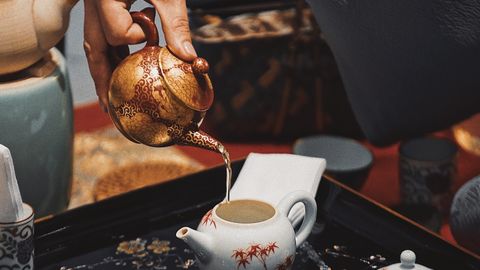
This is the category that most rewards gongfu brewing.
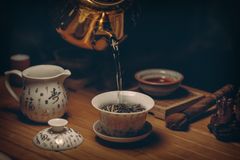
Gongfu approach. Five to seven grams in a hundred millilitre gaiwan or small pot. Water at ninety to one hundred degrees depending on style. Rinse the leaves briefly and discard.
Then infusions of ten to twenty seconds, increasing slightly each time.
Good oolong yields eight to fifteen infusions, each distinctly different. Rolled oolongs open gradually and frequently peak around the third or fourth steep.
Western approach. Three grams per two hundred millilitres, ninety to ninety-five degrees, two to three minutes, resteeped two or three times.
Acceptable, and it misses most of what the tea does.
Temperature by style
Lightly oxidised green oolongs: eighty-five to ninety-five degrees.
Heavily oxidised and roasted oolongs: ninety-five to one hundred.
Roasted teas want hot water. Delicate floral ones do not.
Roasting and ageing
A dimension unique to certain oolongs.
Charcoal roasting, applied over hours or days and sometimes repeated over years, transforms the tea — reducing green character, developing depth, and stabilising it for storage.
Heavily roasted oolongs can be aged for years or decades, mellowing and developing complexity.
A freshly roasted tea can taste harsh and needs months of rest before the roast integrates, which is why some vendors sell rested teas at a premium.
Where to start
Buy a Taiwanese high mountain oolong and a Wuyi rock tea, and drink them in the same week.
They are so different that the contrast teaches the category faster than any description.
Then follow whichever direction interested you. Each end of the range has enormous depth.
Storage
Lightly oxidised oolongs are perishable and should be kept sealed and cool, drunk within a year.
Roasted oolongs are stable and improve with careful storage, kept airtight at room temperature away from odours.
The same category, opposite storage advice, which is a reasonable summary of oolong generally.