Equipment
Dosing Funnels, Distributors And Puck Prep Tools
The tools that sit between the grinder and the tamp exist to fix distribution rather than compression, and most of them address a problem a better grinder would prevent.

A growing category of small accessories sits between grinding and brewing an espresso shot. Each addresses a specific failure in how ground coffee lands in a basket, and knowing which failure it targets is the only way to judge whether it is worth owning.
Ground coffee does not fall evenly
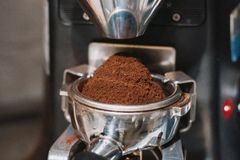
Coffee leaving a grinder arrives as clumps and streams rather than as an even layer. It piles where it lands, and static causes fines to cling to the basket walls and to each other.
An uneven bed means water finds the loose regions first and races through them. That is channeling, and it produces a shot that is simultaneously sour and bitter because parts of the puck are barely touched while others are stripped.
Tamping cannot correct this. Pressing down on an uneven pile compresses the high spots and leaves the density gradient underneath essentially intact.
Funnels and dosing rings keep the grounds contained
A magnetic funnel sitting on the basket rim catches grounds that would otherwise land on the edge or the counter. It makes the dose accurate and the workspace cleaner.
It also allows the bed to be leveled without spilling, since there is a wall above the basket to work against. That is most of its practical value.
What it does not do is redistribute anything. It is a containment tool rather than a distribution tool, and buying one expecting better extraction misreads the purpose.
Distribution tools level the surface
A spinning distributor with angled blades sweeps the top of the bed flat at a set depth. The surface ends up even and the highest clumps are broken.
Because the tool only reaches a short way into the bed, it addresses the top layer rather than density deeper down. That is still useful, since surface irregularity is where many channels begin.
Needle tools go further, stirring the full depth of the dose with fine wires. They break clumps throughout and mix the bed rather than only smoothing it, which is why they tend to produce a larger improvement.
Weight distribution tools have limited effect
Heavy leveling discs that rest on the coffee under their own weight are sold as a way to settle the bed. They compact the surface uniformly and do little below it.
Where a dose is already well distributed, the effect is small. Where it is not, the disc compresses an uneven bed into a uniform-looking surface hiding the same problem.
This is the general pattern with puck prep: tools that mix are more effective than tools that press, because the defect being corrected is arrangement rather than compression.
Grinder quality determines how much any of it matters
A grinder that delivers grounds with little clumping and low static leaves a bed that needs almost no intervention. A quick level and a tamp are enough.
Grinders that clump heavily create the problem these tools exist to solve. Spending on distribution accessories is a way of compensating for the grinder rather than improving on it.
Adding a small amount of water to the beans before grinding reduces static substantially and costs nothing. It is worth trying before any accessory is bought.