Water & Grind
Filters: paper, metal and cloth
A cheap variable with a measurable effect on the cup, and one most people never experiment with.
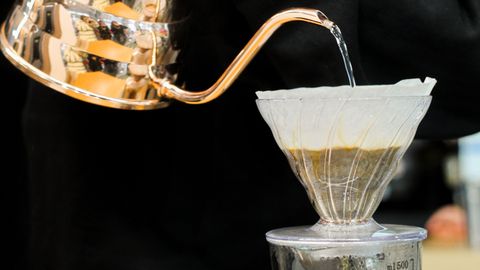
The filter determines what reaches the cup and what stays behind, and different filters produce noticeably different coffee from identical brewing.
Paper
The most common and the most filtering.
Paper traps oils and almost all fine particles, producing a clean, transparent cup with high clarity and lighter body.
Bleached versus unbleached. Bleached filters — white — are treated with oxygen or chlorine-free processes in most modern production.
Unbleached filters — brown — impart a noticeable papery flavour unless rinsed thoroughly.
Both should be rinsed. Bleached filters benefit less but still improve with a rinse, which also preheats the brewer.
Thickness and flow rate vary considerably between brands, and this is where the interesting variation sits.
Thicker papers slow the flow, extending contact time and increasing extraction for the same grind.
Filters designed for the same brewer from different manufacturers can produce brew times differing by a minute, which is a substantial variable.
If you cannot get your brew time where you want it by adjusting grind alone, changing filter brand is worth trying.
The Chemex filter is a notable case — considerably thicker than most, producing very slow flow and an exceptionally clean cup with almost no body.
Metal
Mesh or laser-cut perforated metal.
Lets oils and fine particles through, producing a heavier body, more texture and less clarity.
Also produces sediment in the cup, more with mesh than with laser-cut.
Advantages. Reusable, no ongoing cost, no waste, no papery taste, and the oils contribute mouthfeel and aroma.
Disadvantages. Sediment, less clarity, and they require proper cleaning — oils accumulate and go rancid, producing a stale taste that people frequently blame on their coffee.
Clean metal filters thoroughly and periodically deep clean them.
Laser-cut filters with very fine precise holes produce results closer to paper than traditional mesh, at higher cost.
Cloth
The traditional option, still used in several coffee cultures — Central American, Japanese nel drip, and various regional traditions.
Cloth filters oils partially, producing a cup between paper and metal: substantial body with reasonable clarity.
Many people who have tried all three consider cloth the best compromise.
The catch is maintenance. Cloth absorbs oils and harbours bacteria. It must be rinsed thoroughly after every use, stored wet in the refrigerator or in water, and never washed with detergent.
A cloth filter that has been allowed to dry out with oils in it is ruined and will taint everything.
This maintenance requirement is why cloth remains a minority choice despite the quality.
Filters last for dozens of uses and should be replaced when they no longer rinse clean.
What the differences taste like
The most instructive experiment available: brew the same coffee three times, identically, changing only the filter.
Paper. Clean, articulated, lighter, more acidity apparent, less body.
Metal. Heavier, rounder, more texture, less definition, some sediment.
Cloth. Between the two, with substantial body and good clarity.
The differences are obvious side by side and easy to miss in isolation.
The cholesterol point
Worth mentioning because it comes up.
Coffee contains diterpenes — cafestol and kahweol — which have been associated in research with raised LDL cholesterol.
Paper filters trap most of them. Metal filters, cloth to a lesser degree, French press and boiled coffee methods do not.
Whether this matters for any individual depends on how much coffee they drink and their overall risk profile, and it is a question for a clinician rather than a coffee writer.
The factual point is simply that paper filtering removes these compounds and metal filtering does not.
Environmental considerations
Paper filters are compostable along with the grounds, which is the usual disposal route.
Metal and cloth eliminate the consumable entirely, at the cost of water for cleaning.
The differences here are small relative to the footprint of coffee production itself.
The practical recommendation
Try all three with a coffee you know well.
Then match the filter to what you want from a given coffee — paper for delicate bright coffees where clarity is the point, metal or cloth for heavier coffees where body is.
And if you use paper, try two or three brands. It is the cheapest experiment in coffee and the effect on brew time is larger than most people expect.
Also by Marcus Obeng
- What we would tell someone starting outEquipment
- When your coffee suddenly gets worseEquipment
- A morning routine that produces good coffee every dayBrewing Methods
- Coffee grounds and wasteEquipment