Water & Grind
Blade Grinders And What They Actually Do
A blade grinder chops rather than mills, producing particles across a wide size range at once, which sets a ceiling on what any brewing method downstream can achieve.
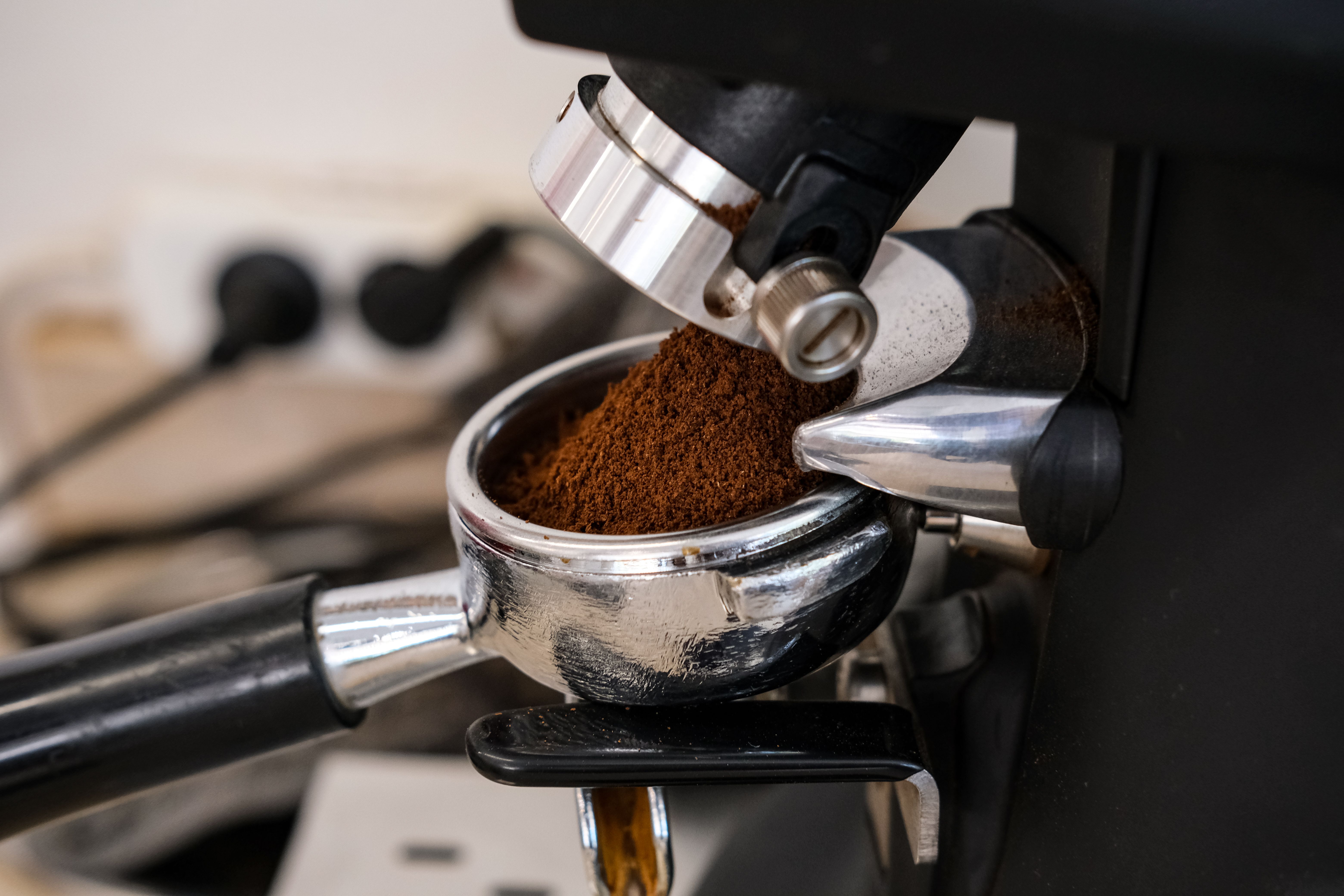
The inexpensive grinder found in most American kitchens uses a spinning blade rather than burrs. It is worth understanding what it does, because the limitation it imposes is not a matter of build quality.
Chopping is not the same as milling
Burrs pass coffee through a gap of fixed width, so particles are reduced until they are small enough to fall through. Size is set geometrically.
A blade strikes beans at random and breaks whatever it hits. Nothing determines how small a fragment becomes except how many times it happens to be struck.
The result is a wide distribution containing both large chunks and very fine dust in the same batch, produced simultaneously rather than progressively.
Wide distribution means uneven extraction
Fine particles give up their solubles quickly and continue past the point of balance. Large fragments extract slowly and never reach it.
A brew made from both contains over-extracted and under-extracted coffee in the same cup. The taste is bitter and sour at once, which is a distinctive signature.
No brewing adjustment resolves this, because the two populations require opposite corrections. Grind uniformity is upstream of everything else.
Running longer makes it worse in a specific way
Extended grinding does reduce the largest fragments, but it also pulverizes what is already fine into dust. The range widens rather than narrowing.
Heat builds as well, since the blade is doing work on the coffee continuously. Aromatics are driven off before the coffee reaches water.
Pulsing in short bursts and shaking the chamber between them improves matters somewhat by redistributing beans. It reduces the problem without removing it.
Some methods tolerate it better than others
Espresso is essentially impossible, because it depends on a narrow particle range to build even resistance across the puck.
Long immersion methods are the most forgiving, since extended contact time gives coarse particles a chance to catch up.
Cold brew is the most forgiving of all. Very long steeping at low temperature flattens much of the difference between particle sizes.
Where the money goes when upgrading
An entry-level burr grinder produces a noticeably narrower distribution than any blade grinder, and the improvement in the cup is immediate.
Beyond that, additional spending buys better burr geometry, more consistent alignment and lower retention. Those are refinements on a solved problem.
For anyone brewing with pre-ground coffee or a blade grinder, this is the single change that produces the largest difference for the money.
Also by Marcus Obeng
- What we would tell someone starting outEquipment
- When your coffee suddenly gets worseEquipment
- A morning routine that produces good coffee every dayBrewing Methods
- Coffee grounds and wasteEquipment