Brewing Methods
Siphon brewing, and why it survives
A theatrical vacuum brewer from the nineteenth century that produces a genuinely distinctive cup, if you can be bothered.
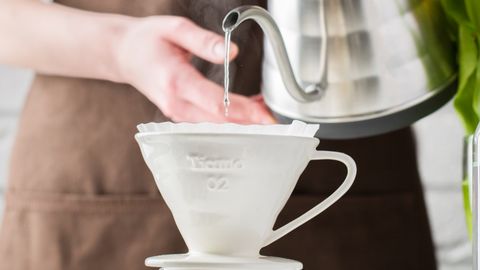
A siphon, or vacuum brewer, uses vapour pressure and a vacuum to move water up into a chamber with coffee and then pull the brewed liquid back down through a filter.
It looks like laboratory glassware, requires attention throughout, and produces coffee with a clarity and aromatic intensity that is difficult to match.
How it works
Two chambers, connected by a tube, with a filter at the join.
Water in the lower bulb is heated. As it approaches boiling, expanding vapour pushes the water up the tube into the upper chamber, where the coffee is.
Brewing happens in the upper chamber at a stable, near-boiling temperature.
When the heat is removed, the lower bulb cools, the vapour condenses, and the resulting pressure drop pulls the brewed coffee back down through the filter.
The physics are visible throughout, which is a large part of the appeal.
The method
Preheat the water. Fill the lower bulb with hot water from a kettle. Heating from cold takes a long time and produces uneven results.
Fit the filter in the upper chamber, hooked onto the tube, and seat it centrally.
Place the upper chamber loosely at first, letting the water heat, then seat it properly.
Wait for the water to rise. Most of it will migrate up; a small amount stays behind.
Add the coffee once the water has risen and stabilised.
Medium-fine grind, around 1:15 ratio.
Stir gently to wet all the grounds evenly. This matters — dry clumps floating on top extract nothing.
Brew for around a minute to ninety seconds, with a gentle stir partway.
Remove the heat.
Stir once more as the drawdown begins, which helps the bed settle evenly.
The coffee is pulled down through the filter, and the spent grounds should form a flat dome in the upper chamber.
A drawdown taking twenty to forty seconds is about right. Much longer suggests too fine a grind or a clogged filter.
Filters
Cloth is traditional and produces the classic siphon character — good body with excellent clarity.
Requires the same maintenance as any cloth filter: rinse thoroughly, store wet, never use detergent.
Paper filters cut for siphons produce a cleaner, lighter cup.
Metal filters are reusable and pass more oils and fines.
Glass rod filters exist for some designs and are the least filtering of all.
Heat sources
Butane burners give good control and are the common choice.
Alcohol burners are traditional, quieter and less controllable.
Halogen beam heaters are precise, fast and expensive, and are what cafés with siphon bars typically use.
A gas hob works for stovetop models with a diffuser.
Whatever the source, the key is being able to reduce or remove heat quickly at the end.
Why the cup is distinctive
Three factors.
Immersion at stable high temperature. All the coffee sits in all the water at close to boiling, for the whole brew — a very even extraction at a temperature higher than most methods achieve.
Cloth or paper filtration on the way out, which removes fines and produces clarity.
The sealed chamber, which retains aromatics that escape from an open brewer.
The result combines the body of an immersion method with the clarity of a filtered one, plus unusual aromatic intensity.
The difficulties
It is glass, and it breaks.
It requires attention throughout, which defeats the purpose for a weekday morning.
Cleaning involves several parts including a fiddly filter.
The seal between chambers must be intact; a worn gasket prevents the vacuum from forming properly.
And there is an open flame or a hot element involved, which requires basic care.
Troubleshooting
Water does not rise fully. Insufficient heat, or the seal is not seated properly.
Water rises then falls back during brewing. Heat has dropped too far. Maintain gentle heat during the brew.
Very slow drawdown. Grind too fine, filter clogged, or too many fines.
Coffee tastes flat. Grounds were not properly wetted. Stir more thoroughly at the start.
Bitter. Brewed too long, grind too fine, or heat too aggressive during the brew.
Who it suits
People who enjoy process, who have twenty minutes, and who want to serve coffee to guests in a way that is genuinely impressive.
It is also excellent for delicate, aromatic coffees — light-roast Ethiopians and Kenyans in particular — where the clarity and aromatic retention show them at their best.
As a daily driver it is impractical, which is why it remains a weekend method and a café showpiece rather than a mainstream one.
Also by Marcus Obeng
- What we would tell someone starting outEquipment
- When your coffee suddenly gets worseEquipment
- A morning routine that produces good coffee every dayBrewing Methods
- Coffee grounds and wasteEquipment