Brewing Methods
Making coffee while travelling
Hotel rooms, campsites, offices and trains — where good coffee is possible with surprisingly little.
Away from a kitchen, the constraints are equipment, hot water and mess. All three are solvable.
The minimum viable kit
A hand grinder, an Aeropress or a collapsible cone, filters, and a way to heat water.
That fits in a small bag and produces genuinely good coffee anywhere.
Add a small scale if you are precise about it, and most people manage without.
The Aeropress case
It is the travel brewer by consensus, for good reasons.
Plastic and unbreakable. Self-contained. Fast. Cleans by pressing the puck out and rinsing. Works with any cup or bottle wide enough.
It also tolerates imprecision, which matters when you are guessing quantities in a hotel room.
The smaller travel version exists, and the standard one is not large.
Alternatives
Collapsible silicone cones pack flat and work with standard filters. Very light, and they require a controlled pour, which hotel kettles do not provide.
Steel cone filters that sit on a mug. No paper needed, more sediment.
Filter bags — single-serve drip bags that hang on a cup rim, pre-filled with ground coffee.
Widely sold in East Asia and increasingly elsewhere. Genuinely good if the coffee is good and recently packed, and they require nothing but hot water.
Some roasters will make them from their own coffee.
Instant coffee. Worth reconsidering.
Specialty instant coffee — freeze-dried from carefully sourced and roasted beans — has improved enormously and is now genuinely acceptable, if not equal to fresh brewing.
For a mountain, a plane, or a situation with nothing but a kettle, it is the correct answer.
Steeped coffee bags, like tea bags with coffee. Convenient, generally mediocre because the grind is fine and stale, and adequate in a pinch.
The hot water problem
Hotel kettles are frequently limescaled, sometimes used for other purposes, and always boil-only.
Rinse and boil once before using, discarding that water.
For temperature, boil and wait a minute or two.
A small travel kettle is worth carrying for anyone travelling frequently and staying somewhere without one.
For camping, any stove works. A pot and a stove are all that is required.
Grinding on the road
A hand grinder is the right answer. Compact, no power, and quality that matches expensive electric grinders.
Several models are designed specifically for travel, packing inside an Aeropress chamber.
Pre-ground is the alternative, and it stales quickly. If you must, grind on the morning you leave, seal it tightly, and accept the decline over a few days.
Better: take whole beans and a grinder for trips over three days, pre-ground for a single overnight.
Camping
Options beyond the above:
Cowboy coffee. Coarse grounds boiled in a pot, allowed to settle, poured carefully.
Add a splash of cold water at the end to help the grounds settle.
Crude and it works, and it requires nothing but a pot.
An enamel percolator, which is traditional and produces over-extracted coffee, and which many campers genuinely prefer for the associations.
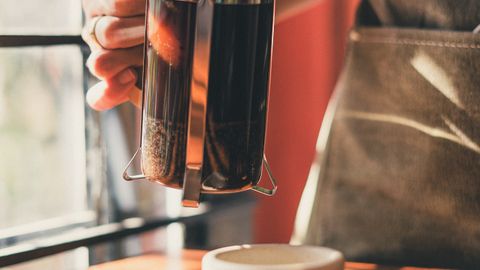
A French press in stainless steel, which is unbreakable and doubles as a vessel.
The real camping constraints are weight, fuel and cleaning water. Methods that require rinsing large quantities of grounds are impractical where water is carried.
The office
Different constraints: a shared kettle, no privacy, and limited storage.
An Aeropress or a small cone in a drawer, a hand grinder if the noise is acceptable, and a bag of beans stored sealed.
Grinding at an open-plan desk is antisocial. Grinding in a kitchen is fine.
For most offices, a small burr grinder at home and a sealed daily portion is the practical compromise, accepting a day of staling.
Water elsewhere
Travelling changes your water, which changes your coffee.
A recipe that worked at home may produce sour or flat coffee somewhere with very different water.
The adjustment is the usual one — if it tastes flat and dull, the water is likely hard; if harsh and thin, possibly very soft.
Bottled water is the simple fix where the tap water is clearly the problem.
Buying coffee where you are
Frequently the best option, and one of the pleasures of travelling.
Find a local roaster or a good café, buy a small bag, and drink where you are.
It is fresher than anything you carried, it supports someone local, and it is a considerably better souvenir than most.
The honest position
Travel coffee is a compromise and it does not have to be a bad one.
A hand grinder, an Aeropress and a bag of good beans produce coffee better than most cafés, in a hotel room, in five minutes.
Whether carrying that is worth it depends on how much you care, which is a question only you can answer at six in the morning in an airport.
Also by Marcus Obeng
- What we would tell someone starting outEquipment
- When your coffee suddenly gets worseEquipment
- A morning routine that produces good coffee every dayBrewing Methods
- Coffee grounds and wasteEquipment