Brewing Methods
Pour over, properly
The most controllable brewing method and the one most sensitive to sloppiness, which is why it rewards attention.
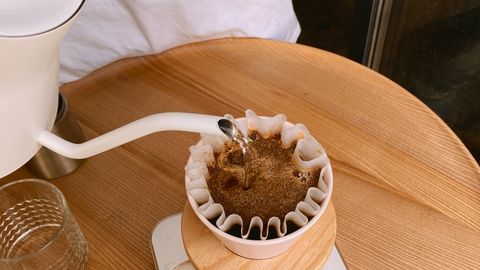
Pour over is water poured through a bed of coffee in a filter, with gravity doing the work.
Nothing about it is complicated. Everything about it is sensitive.
The basic recipe
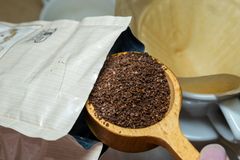
A ratio around sixty grams of coffee per litre of water — roughly fifteen grams of coffee to two hundred fifty of water — is a sound starting point.
Medium grind, somewhere around table salt.
Water just off the boil, around ninety-three degrees Celsius.
Total brew time of two and a half to three and a half minutes for a single cup, longer for larger batches.
The sequence
Rinse the filter with hot water. This removes papery taste and preheats the brewer and the vessel.
Discard the rinse water.
Add the coffee and level the bed. A flat bed extracts more evenly than a sloped one. Tap the brewer gently.
Bloom. Pour roughly twice the coffee weight in water — thirty grams for fifteen grams of coffee — and wait thirty to forty-five seconds.
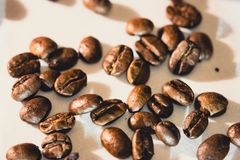
Fresh coffee releases carbon dioxide, which repels water and creates channels. The bloom lets that gas escape.
You can see how fresh the coffee is by how much it swells. Stale coffee barely moves.
Pour in stages. Slow, controlled, in circles from the centre outward, avoiding the very edge of the filter.
Water running down the side of the filter bypasses the coffee entirely, which is exactly what you do not want.
Finish the drawdown. The bed should be flat when it drains, not a crater with a mound around the edge.
Reading the bed afterward
The spent grounds tell you what happened.
Flat and even. Good extraction.
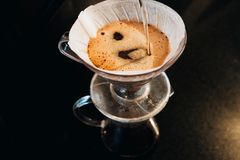
A deep crater in the middle with high walls. You poured too aggressively in one spot, and the outer grounds under-extracted.
Visible holes or channels. Water found a fast route. Usually caused by an uneven bed, aggressive pouring, or a grind with too many fines.
Grounds high up the filter walls. Coffee was pushed up and out of the water flow. Use a gentler pour, or a swirl at the end to settle the bed.
The common problems
Draining too fast, tastes sour. Grind finer. Also check that you are not pouring so quickly that the water level never has time to work through the bed.
Draining too slowly, tastes bitter. Grind coarser. Slow drawdown is frequently caused by fines — the very small particles a poor grinder produces — clogging the filter.
Stalling completely. Too fine, too many fines, or a filter that has folded against the brewer wall.
Tastes flat and dull. Water too cool, or coffee too old.
Conical versus flat bottom
The two main shapes, and they behave differently.
Conical brewers — a cone with a large single hole — give the water a longer path through the centre of the bed and let you control flow largely by pour rate.
More clarity, more room for technique to matter, and more room to get it wrong.
Flat bottom brewers — a wedge or basket with a flat bed and multiple holes — extract more evenly because the bed depth is uniform.
More forgiving, generally more balanced and slightly less bright.
Neither is better. Flat bottom is easier to be consistent with; conical rewards practice.
The water matters more than the brewer
Worth saying here because people buy brewers to fix problems that are actually water problems.
Very hard water dulls acidity and leaves scale. Very soft or distilled water extracts poorly and tastes hollow.
If your coffee tastes flat regardless of technique, try a bottle of low-mineral spring water as a test. The difference is frequently dramatic.
Scaling up
Larger batches need adjustment. A bigger bed is deeper, so water takes longer to pass through, so you generally need a coarser grind.
Pour in more stages, keeping the water level relatively stable rather than filling it and walking away.
And expect the first few attempts at a new size to be wrong. Every change of scale is effectively a new recipe.
Also by Marcus Obeng
- What we would tell someone starting outEquipment
- When your coffee suddenly gets worseEquipment
- A morning routine that produces good coffee every dayBrewing Methods
- Coffee grounds and wasteEquipment