Brewing Methods
Why The Office Coffee Pot Tastes Flat By Ten
Office coffee is rarely bad because of the beans. Long holding times on a hotplate, oversized batches and a machine that never gets cleaned explain most of the flavor.
Coffee made in a shared office kitchen tends to taste dull, papery and slightly burnt. Almost none of that comes from the coffee itself.
Holding time does most of the damage
A pot brewed at eight and finished at ten has spent two hours losing aromatics to the air. The volatile compounds that make coffee smell like anything are the first to leave.
What remains is the heavier, less pleasant fraction. The drink still tastes of coffee, but the top notes that made it interesting are gone before most of the office arrives.
This is why the first cup from a fresh pot is noticeably better than the fourth. The difference is time, not the pour.
The hotplate keeps cooking what is already brewed
A glass carafe on a warming plate is being heated from below continuously. The liquid nearest the glass is effectively simmering, which develops a scorched, tarry character.
That character then spreads through the pot by convection. A carafe that has sat for an hour tastes burnt even when the brew itself was extracted correctly.
Insulated servers avoid this entirely by holding heat rather than adding it. Where an office keeps its glass pot, brewing smaller and more often is the only real remedy.
Batch size is set by the machine, not the room
Most office brewers make a full pot or nothing. If four people want coffee, twelve cups get made anyway, and the surplus sits.
Machines that brew half batches often do it badly, spraying the same water pattern over a smaller bed. The result is an over-extracted half pot rather than a well-made one.
The pattern rewards whoever brews last and punishes whoever brews first. Nobody is doing anything wrong; the equipment simply assumes constant demand that offices do not have.
Nobody owns the cleaning
Coffee oils oxidize and turn rancid on any surface they sit on. Brew baskets, spray heads and carafes accumulate a film that flavors everything passing through them.
Shared equipment gets rinsed rather than washed, because rinsing is what a person does on the way back to a desk. The residue builds slowly enough that nobody notices the decline.
Descaling is skipped for the same reason. Scale inside the heating element lowers brew temperature over time, which pushes the whole pot toward sourness.
Pre-ground bulk coffee starts at a disadvantage
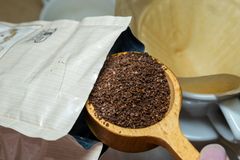
Coffee bought in large pre-portioned packs is ground long before it is brewed, and ground coffee stales in days rather than weeks. Sealed packets slow this but do not stop it.
Grind size in those packets is set for a generic drip machine, which may not match the one in the room. There is no way to correct it without a grinder.
An office that adds only a grinder and an insulated server usually gets a bigger improvement than one that upgrades the coffee. The failures are mechanical before they are agricultural.
Also by Marcus Obeng
- What we would tell someone starting outEquipment
- When your coffee suddenly gets worseEquipment
- Coffee grounds and wasteEquipment
- Recipe notebooks and dialling in systematicallyWater & Grind