Brewing Methods
Pulse Pouring Versus One Continuous Pour
Splitting a pour over into several pulses changes agitation and bed depth rather than total time, which is why the two approaches suit different grinders and different roasts.
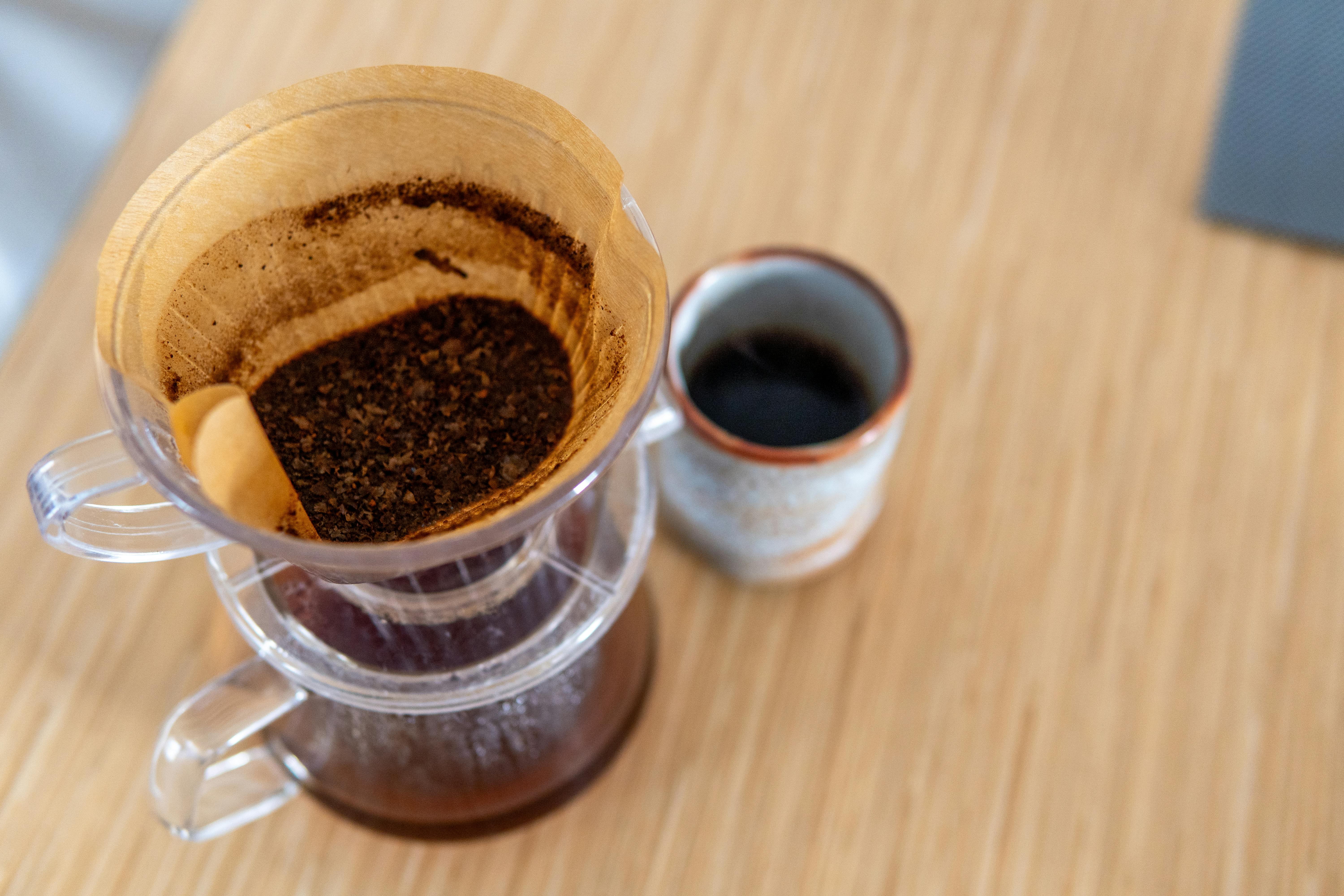
Pour over recipes divide roughly into those that add water in stages and those that add it in one long stream. The choice affects the cup in ways that have little to do with total brew time.
Pulses reset the water level repeatedly
Each pulse raises the slurry, then lets it draw down before the next one. The bed is therefore alternately flooded and drained across the brew.
That cycling moves grounds around and brings fresh water into contact with particles that were sitting in saturated liquid. Extraction becomes more even as a result.
The cost is control. Every pulse is a decision about timing and volume, and small inconsistencies between pours accumulate into cup-to-cup variation.
A continuous pour holds a steadier slurry
Pouring in one stream keeps the water level roughly constant once it stabilizes. The bed stays submerged and the flow through it settles into a steady state.
This produces a gentler brew with less agitation, which suits coffees that turn harsh when worked hard. Delicate light roasts often show more sweetness this way.
It also depends more on the grinder. Without the mixing that pulses provide, an uneven grind extracts unevenly and there is nothing in the method to compensate.
Bed depth changes as the brew proceeds
Grounds settle downward through a pour over as water passes through them. A single pour compacts the bed early and leaves it compacted.
Pulsing disturbs that settling, keeping the bed looser for longer. Flow rate through a loose bed is faster, which is why pulsed recipes often need a finer grind for the same time.
Neither state is correct in itself. What matters is that the grind is matched to the bed the method produces, rather than carried over from another recipe.
Total time is a poor way to compare them
Two recipes finishing at three minutes can extract very differently if one agitated the bed four times and the other never did. Time measures the drawdown, not the work done.
Tasting is the only reliable comparison. A pulsed brew that tastes drying is over-extracted despite matching the timer on a continuous brew that tastes flat.
Recipes copied from elsewhere usually specify time because it is easy to write down. The agitation they assume is rarely stated and rarely transfers.
Choosing between them is mostly about your grinder
A grinder producing a narrow particle range gives a continuous pour enough uniformity to work well. Sweetness and clarity come easily and the method stays simple.
A grinder producing more fines and more boulders benefits from the mixing that pulses provide. The method compensates for what the equipment cannot deliver.
Roast level pushes the same way. Darker roasts give up solubles quickly and often prefer the gentler continuous approach, while dense light roasts tolerate and reward the extra work.
Also by Marcus Obeng
- What we would tell someone starting outEquipment
- When your coffee suddenly gets worseEquipment
- Coffee grounds and wasteEquipment
- Recipe notebooks and dialling in systematicallyWater & Grind