Brewing Methods
Immersion Versus Percolation, And What Changes
Every brewing method sits in one of two families, and the difference in how water meets the grounds explains most of what separates the resulting cups.
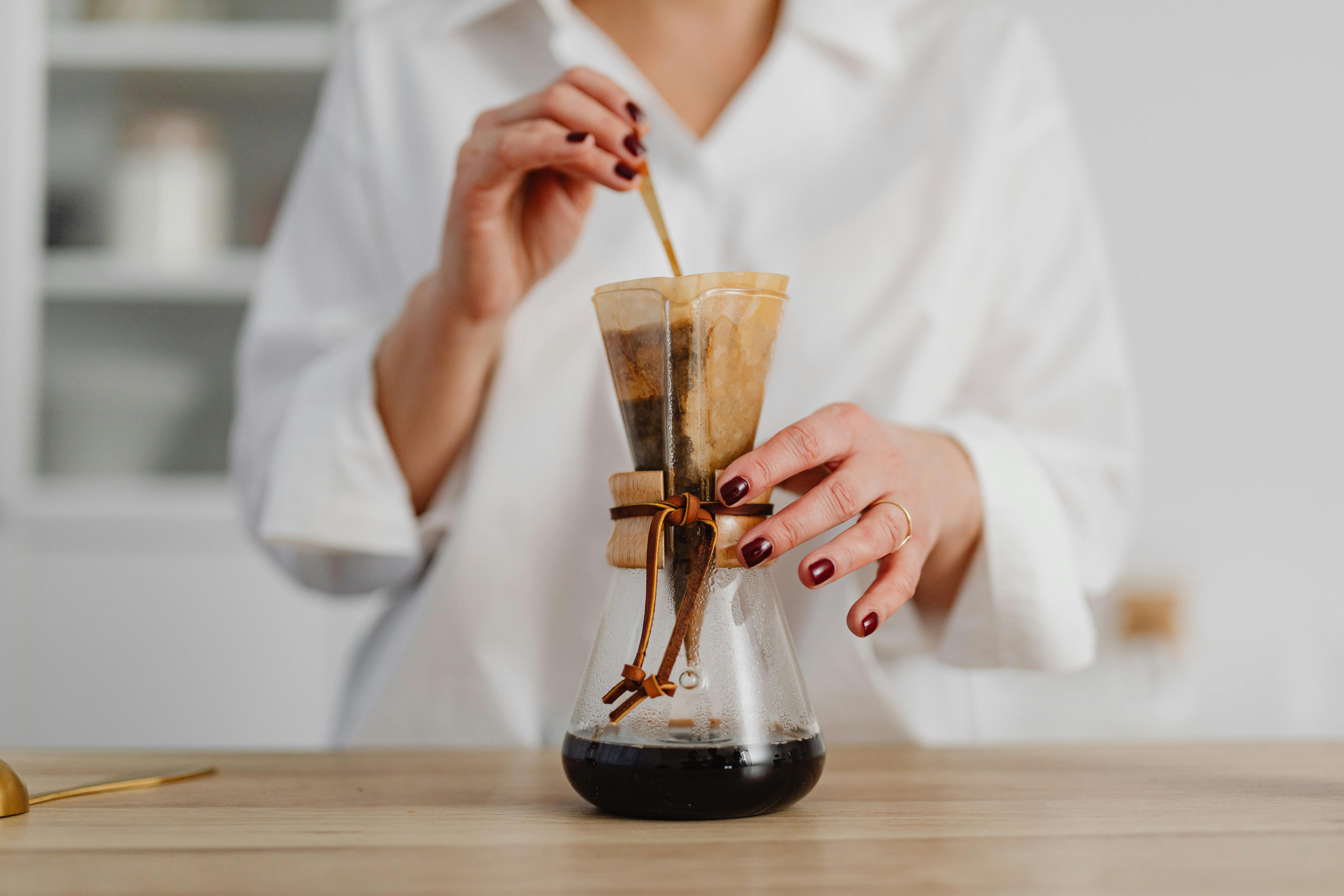
Brewing methods look varied on a kitchen counter, but almost all of them belong to one of two families. Knowing which family a device belongs to predicts more about the cup than the brand on the box.
The two families are defined by water movement
In immersion brewing the grounds sit in a fixed body of water for the whole extraction. A French press, a cupping bowl and a steeped tea basket all work this way.
In percolation the water moves through a bed of grounds and leaves, carrying dissolved material away with it. Pour over, drip machines and espresso are all percolation, despite looking nothing alike.
The distinction is not decorative. It changes the concentration gradient at the surface of every particle, which is the thing that actually drives extraction.
Immersion reaches an equilibrium
Water that sits still gradually saturates with dissolved coffee, and as it does, extraction slows. The system approaches a ceiling and then hovers there.
That ceiling makes immersion forgiving. An extra minute in a French press changes the cup far less than an extra minute would change a pour over, because most of the available material has already moved.
The trade-off is a lower practical extraction. The grounds nearest the centre of a settled bed are surrounded by water that has already taken what it can hold.
Percolation keeps the gradient steep
Fresh water arriving at the bed is always less saturated than the water leaving it. The gradient never flattens, so extraction continues at close to full rate until the water runs out.
This is why percolation can reach higher extraction in less time. It is also why percolation punishes small errors, since nothing self-limits once the water has found an easy path.
Flow rate becomes the controlling variable, and flow rate depends on grind, bed depth and the filter. Three things that all interact.
Hybrid devices borrow from both
Several popular brewers deliberately combine the families. A steeping phase is followed by a pressed or drained phase, so the brew begins forgiving and finishes with a rinse of cleaner water.
Siphon brewers do something similar in reverse, holding the coffee in suspension before drawing it down through a filter. The result tastes fuller than pour over but cleaner than a press.
These devices are not compromises so much as attempts to get the tolerance of immersion with the clarity of flow.
Which family you have decides what to adjust
If a press tastes weak, the useful levers are dose, water temperature and time. Grinding finer helps only up to the point where the filter stops holding the sediment back.
If a pour over tastes weak, the useful lever is almost always flow. A finer grind or a slower pour keeps water in contact longer, which no amount of extra time in the cup can substitute for.
Diagnosing a bad brew starts with asking which family you are working in, because the same symptom has different causes in each.
Also by Marcus Obeng
- What we would tell someone starting outEquipment
- When your coffee suddenly gets worseEquipment
- Coffee grounds and wasteEquipment
- Recipe notebooks and dialling in systematicallyWater & Grind