Brewing Methods
Agitation Is A Variable You Control
Stirring, swirling and pour turbulence change extraction as reliably as grind size does, yet most recipes leave the amount of agitation entirely unstated.
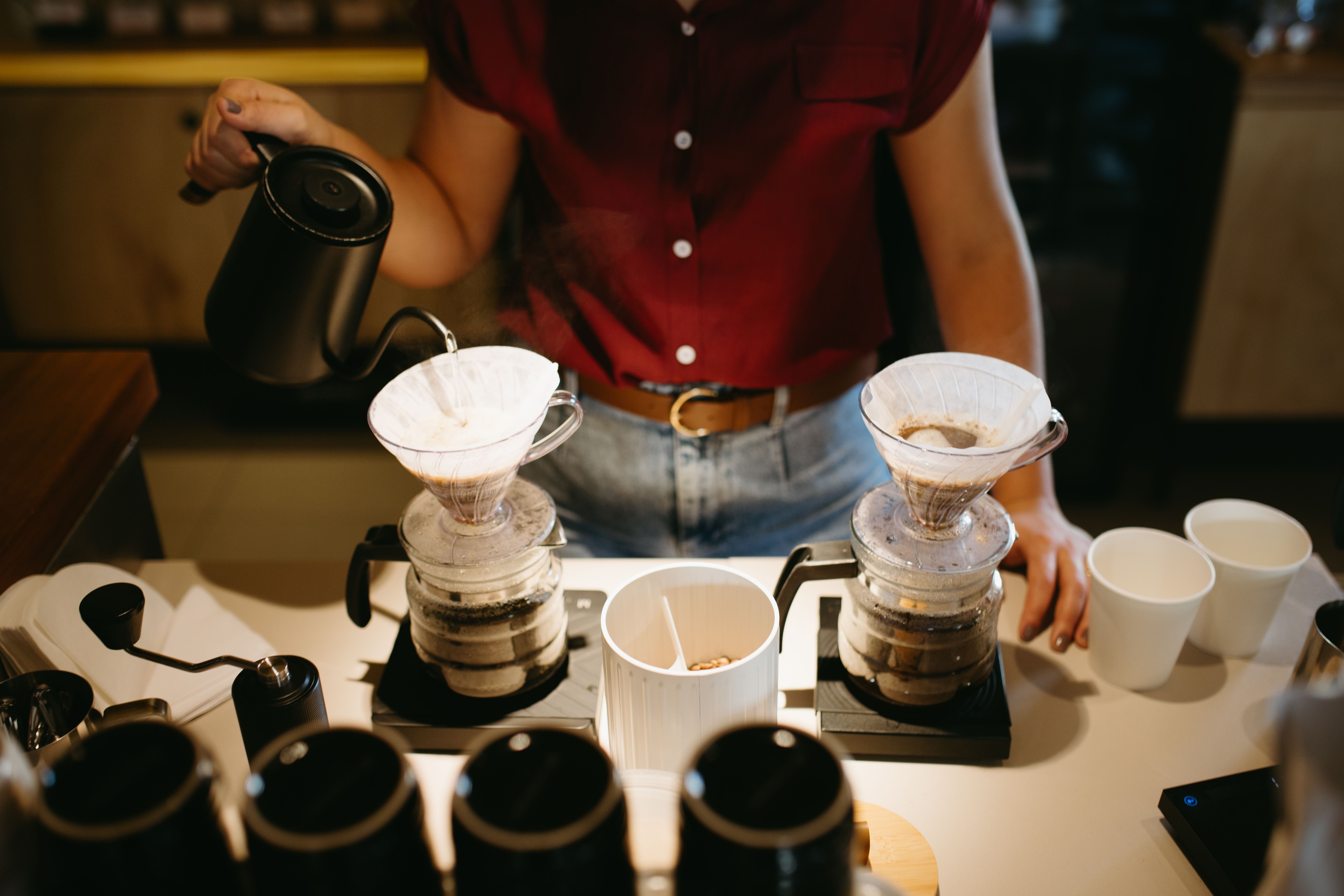
Recipes specify dose, water and time, and almost never specify how much the brew was disturbed. Agitation is a real variable, and leaving it unstated is why two people following the same recipe get different cups.
Agitation moves saturated water away from particles
Extraction happens at the surface of each ground particle, where dissolved material builds up in a thin boundary layer. That layer slows further extraction by reducing the concentration difference.
Any movement in the brew replaces that saturated layer with fresher water. The gradient steepens again and extraction speeds up.
This is why a stirred immersion brew extracts more than an undisturbed one at identical time, temperature and grind.
Pouring is agitation whether you intend it or not
A high, fast stream drops energy into the bed and churns the grounds. A low, gentle stream barely disturbs them. Both count as pours in a recipe that says only pour to 300 grams.
Kettle choice therefore changes the cup. A gooseneck delivers a narrow controlled stream; a wide domestic spout delivers a broad turbulent one at the same volume.
Neither is wrong, but they are not interchangeable, and switching kettles usually requires adjusting grind to compensate.
Too much agitation has its own signature
Aggressive stirring in a percolation brew drives fine particles down into the filter, which slows drainage and stretches contact time beyond what was planned.
The cup that results is often bitter and drying, and the natural response of grinding coarser only makes the unevenness worse rather than better.
A stalled pour over is more often an agitation problem than a grind problem, and the fix is a gentler pour rather than a bigger change to the grinder.
Different methods tolerate different amounts
Immersion methods are relatively robust, since there is no filter bed to disturb and no drainage to slow. Stirring a press is mostly upside.
Flat bed brewers tolerate less than conical ones, because the shallow bed offers fewer paths for water to redistribute if the surface gets churned.
Espresso tolerates almost none once the puck is compressed, which is why distribution work happens before tamping and not after.
Write it down like any other variable
If you record grind and ratio but not agitation, your notes will contain unexplained results that look like equipment faults or bad beans.
A simple description is enough: one swirl after the bloom, gentle centre pours, no stir at the end. Repeatable language is all that is required.
Once agitation is fixed and written down, changes to grind and temperature start producing the consistent responses that make dialling in possible.
Also by Marcus Obeng
- What we would tell someone starting outEquipment
- When your coffee suddenly gets worseEquipment
- Coffee grounds and wasteEquipment
- Recipe notebooks and dialling in systematicallyWater & Grind